How AI Fashion Tools Are Changing the Way We Dress in 2026
In 2026, AI doesn't just recommend what to buy - it analyzes what you already own, scores your outfits in real time, and suggests improvements with more precision than a human stylist. Here's how the technology works and what it means for your wardrobe.
By Saad Sellami
Founder, OutfitScore
Published: November 10, 2025
Reading time: 7 minutes
Quick Answer
AI fashion tools use computer vision to analyze outfit photos across 6 dimensions: color harmony, fit and proportion, cohesion, dress-code accuracy, trend relevance, and finishing details. They deliver objective, data-driven feedback in seconds that would take a human stylist 30-60 minutes. The technology is faster, more consistent, and more private than human stylists - but understanding how it works helps you use it effectively.
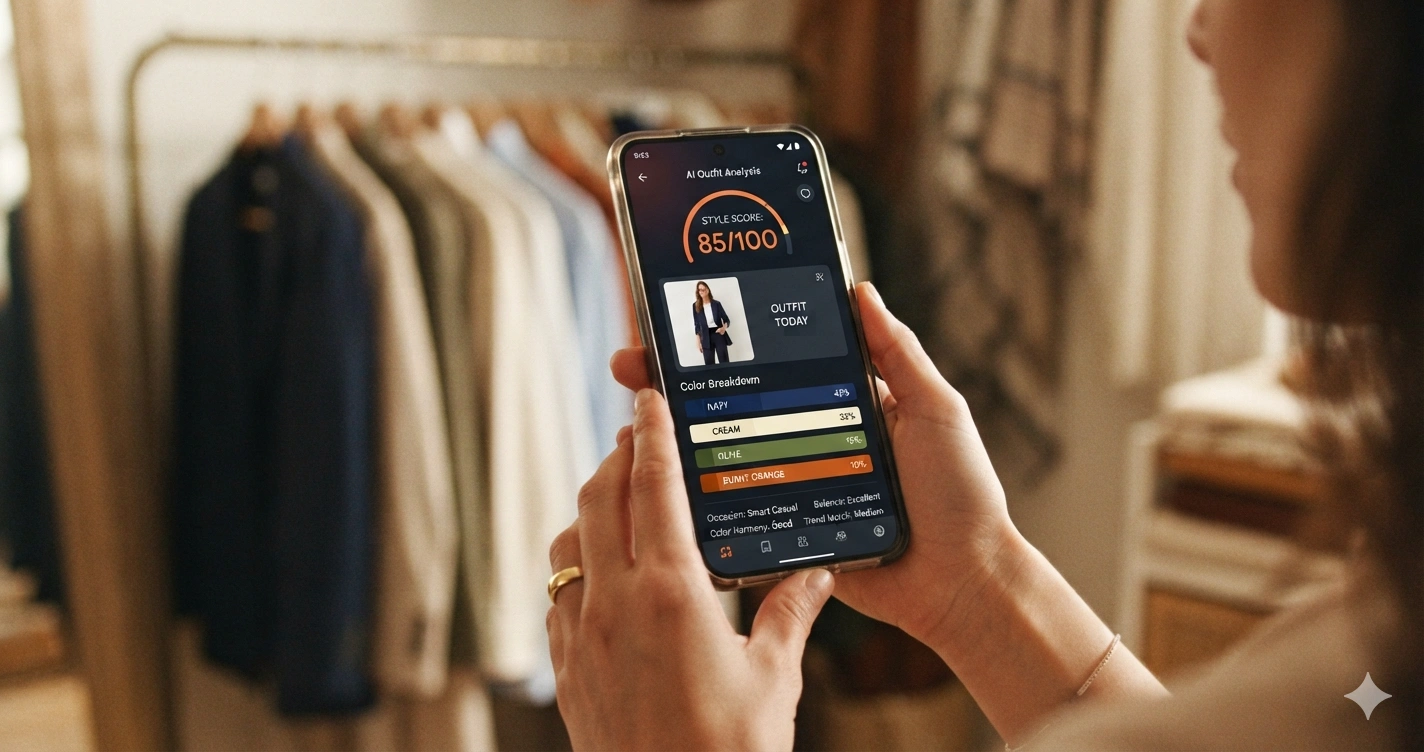
AI fashion analysis: fast, objective, and surprisingly nuanced
The fashion industry has always been about human intuition - stylists, editors, and designers relying on taste and experience. But in the last two years, AI has entered fashion in a way that fundamentally changes how we approach getting dressed. It's no longer about what a machine tells you to buy; it's about a machine helping you understand why certain combinations work and others don't.
The global AI-in-fashion market exceeded $4 billion in 2025, and tools like OutfitScore are at the forefront of a shift from "AI shopping assistant" to "AI personal stylist." Here's what that shift means for you.
4 Ways AI Beats Human Stylists
Human stylists are excellent, but they have inherent limitations that AI does not. Here are the four biggest advantages:
Speed and Scale
A human stylist takes 30-60 minutes to analyze a single outfit and provide feedback - limiting them to maybe 10 clients per day. AI analyzes an outfit in under 10 seconds and can handle unlimited concurrent users. For the average person, this means you can test 5 different outfit combinations before a date or interview and get feedback on all of them in under a minute, rather than booking a stylist appointment days in advance.
Consistency (No Bad Days)
Human stylists have biases, bad days, and personal preferences that influence their recommendations. A stylist who personally dislikes the color orange will subtly steer clients away from it, even if orange happens to be one of the client's best colors. AI applies the same objective criteria to every outfit, every time. A navy blazer with cream trousers always gets the same color harmony score regardless of when you upload it or who's on the other end.
Data-Driven Pattern Recognition
After analyzing hundreds of thousands of outfits, AI detects patterns that no individual stylist can see. For example, our data shows that outfits scoring above 85 consistently use exactly two textures, while outfits scoring below 60 almost always only use one. A human stylist might notice this intuitively over a career, but AI quantifies it precisely and can give you the specific fix: "add a textured accessory." This is data-driven fashion advice, not opinion.
Privacy and Judgment-Free Feedback
Not everyone is comfortable standing in front of a human stylist being critiqued. AI tools give you objective feedback in private - upload a photo, get a score, try again. No raised eyebrows, no awkward comments, no feeling judged for rewearing the same blazer. For people who are self-conscious about their style or body, this privacy makes all the difference in actually seeking and using fashion advice.
How AI Outfit Scoring Works
When you upload an outfit photo to an AI fashion tool, here's what happens behind the scenes. Understanding the process helps you get better results:
The 6 Dimensions of AI Outfit Scoring
1. Color Harmony (25% of score)
The AI analyzes the color palette of your outfit and evaluates how well the colors complement each other based on color theory. It checks for complementary, analogous, triadic, and monochromatic relationships. It also evaluates whether your color choices match your identified color season. Outfits with 2-3 harmonizing colors score highest. More than 4 competing colors or all-neutrals with no accent both lose points.
2. Fit and Proportion (20% of score)
Computer vision analyzes the relationship between garment edges and body landmarks. Does the shoulder seam hit at the right point? Is the waist defined or lost? Are proportions balanced (e.g., wide pants with fitted top, or vice versa)? Slightly oversized cuts score well when intentional; poorly fitting garments (shoulder seams dropping, pants pooling) lose points.
3. Cohesion (20% of score)
How well do the pieces work together as a complete outfit? This dimension evaluates formality consistency (all pieces at the same level of dressiness), style coherence (minimalist pieces together, eclectic pieces together), and whether accessories complement rather than clash. A formal blazer with gym shorts scores low; a blazer with dark jeans scores high if the formality gap is bridged by the right shoes.
4. Dress-Code Accuracy (15% of score)
When you specify an occasion, the AI evaluates whether your outfit meets that dress code. Cocktail attire means a specific set of expectations; the AI knows them. This dimension rewards specificity - an outfit that perfectly matches a "business casual" dress code scores higher than one that's "close enough." Without a specified occasion, this dimension evaluates general appropriateness based on item types.
5. Trend Relevance (10% of score)
The AI stays updated on current fashion trends and evaluates whether your outfit incorporates contemporary elements. This isn't about slavishly following trends - it's about avoiding outdated combinations that signal "I stopped caring in 2018." Wide-leg trousers, tonal dressing, and defined waists are 2026 positives. Skinny jeans with ballet flats and a peplum top would lose points here.
6. Finishing Details (10% of score)
The small things that separate "dressed" from "styled." Is the shirt tucked or intentionally untucked? Are sleeves rolled to the right point? Is there a belt where one belongs? Are accessories present? Jewelry, watches, bags, and scarves all add points in this category. An outfit with zero accessories rarely scores above 80.
Each dimension is weighted differently, and the final score (0-100) reflects the weighted average. Scores above 85 are considered excellent and "street-style worthy." Scores in the 60-75 range are average - presentable but not exceptional. Scores below 50 indicate significant issues in multiple dimensions.
Common Advantages of AI Fashion Tools
Virtual Try-On
AI maps clothing onto your body image so you can see how items fit before buying. Reducing return rates by up to 40% for retailers that implement it well. Best for: online shoppers who hesitate because they can't visualize fit.
Digital Closet Organization
Upload photos of your clothes and AI categorizes, tags (color, season, formality), and suggests combinations you haven't tried. Best for: people who wear 20% of their wardrobe 80% of the time.
Style DNA Analysis
After analyzing 20+ of your outfits, AI identifies your personal style patterns - your go-to colors, silhouettes, and brands - and tells you what's working and what you're overusing. Best for: people who want to understand their own style.
Privacy and AI Fashion: What You Should Know
Uploading photos of yourself to an AI tool raises legitimate privacy questions. Here's what to look for when choosing an AI fashion tool:
Image Retention Policies
Reputable tools clearly state how long they keep your photos. Some retain indefinitely for model training, others auto-delete after analysis. Always check the privacy policy. The safest tools delete your image immediately after processing and only retain anonymized scoring data. Look for explicit "we do not sell your data" and "images are not used for training" statements.
What the AI Actually Extracts
AI outfit analysis doesn't need or want your face. The most privacy-respecting tools focus exclusively on clothing attributes: fabric type, color, fit, and silhouette. They don't care who you are - they care what you're wearing. If a tool asks for more personal data than seems relevant to fashion analysis, that's a red flag.
Data Security Questions to Ask
Are images encrypted in transit and at rest? Is the processing done on-device or on a cloud server? Where are the servers located (GDPR applies in the EU)? Can you request deletion of all your data? A trustworthy AI fashion tool should answer all of these clearly in its FAQ or privacy policy.
The Future of AI in Fashion (2026 and Beyond)
AI fashion tools are evolving rapidly. Here's what's coming:
Real-time outfit feedback via smart mirrors: Stand in front of a mirror, AI analyzes your outfit in real time, suggests adjustments. Already in prototype at major retailers.
Sustainability scoring: Beyond style, AI will estimate the environmental impact of your wardrobe based on fabric types, brand practices, and estimated garment lifespan.
Personalized AI stylists that learn: Instead of one-size-fits-all scoring, AI will learn your personal style preferences over time and suggest combinations you'd actually wear, not just what's statistically optimal.
On-device processing: As phone processors get more powerful, outfit analysis will move entirely to your device. No cloud, no data transfer, total privacy.
Experience AI Outfit Scoring Yourself
Curious how your outfit scores? Upload a photo and get a detailed analysis across all 6 dimensions in seconds. See what's working, what could improve, and your exact score - completely free.
Score My Outfit FreeAbout the Author: Saad Sellami
Saad is the Founder and Lead Data Analyst at OutfitScore. With a background in software engineering, he analyzes tens of thousands of AI fashion assessments to uncover data-driven insights into how we dress, color theory, and styling patterns. Read more about the OutfitScore mission