Individual Pieces vs Full Outfits: What AI Scores Differently (86 vs 707 Analyses)
The OutfitScore database contains 86 analyses of individual clothing items — a single jacket, one pair of trousers, a lone pair of shoes — alongside over 700 complete outfit analyses. We compared the scoring patterns across both formats to answer: what does AI outfit rating actually evaluate on a single piece, what does it miss, and when should you upload one versus the other?
Disclosure: Some links in this article are affiliate links. As an Amazon Associate, OutfitScore earns from qualifying purchases, at no extra cost to you.
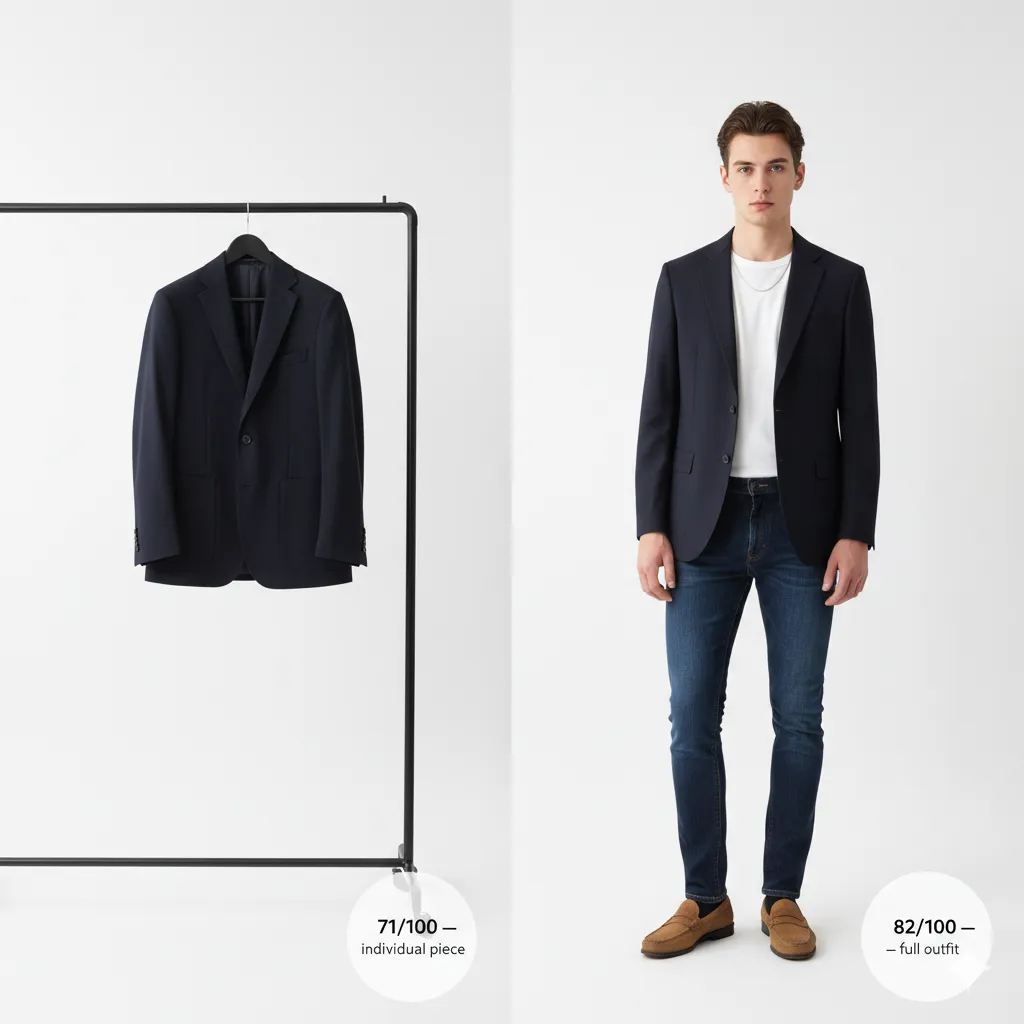
The blazer is identical. The score difference is what the AI gains when it can see how the piece works with other garments.
Advertisement
Individual piece uploads account for about 10% of all fashion analyses in the OutfitScore database — 86 out of the total dataset. They're used by people assessing a new purchase, evaluating whether a garment is worth keeping, or looking for quality feedback on a single item. The AI style analysis for individual pieces is genuinely useful — but it evaluates different things from a full outfit analysis.
Understanding what each format reveals — and what it structurally cannot reveal — tells you exactly when to use which approach.
Advertisement
What Individual Piece Analysis Can Evaluate
When the AI receives a single garment photo, it evaluates what it can see: the piece itself. This maps directly to two of the five scoring dimensions:
✓ Fully assessable on individual pieces
- • Details and quality (fabric, construction, design)
- • Intrinsic colour harmony (does the item's own colours work?)
- • Garment proportions and design quality
- • Versatility potential (how many outfit contexts could this work in?)
✗ Cannot be assessed without outfit context
- • Colour harmony with other pieces
- • Styling and cohesion across the outfit
- • Occasion-appropriateness of the full look
- • Fit and proportion relative to other garments
- • Whether the item actually works with your wardrobe
An individual piece score is essentially a quality and design assessment. It answers: is this a good garment? Not: does it work in this outfit?
The Scoring Range Difference — What the Data Shows
Individual piece scores cluster in a notably narrower range than full outfit scores. Based on the OutfitScore database:
Individual pieces (86 analyses)
Full outfits (707 analyses)
The narrow individual piece range explains something counterintuitive: a mediocre blazer photographed alone might score 65, while the same blazer worn in a badly assembled outfit might score 48 — lower than the piece alone. Conversely, a modest quality blazer in a perfectly assembled outfit might score 78. The outfit context can add or subtract value that the individual piece score cannot capture.
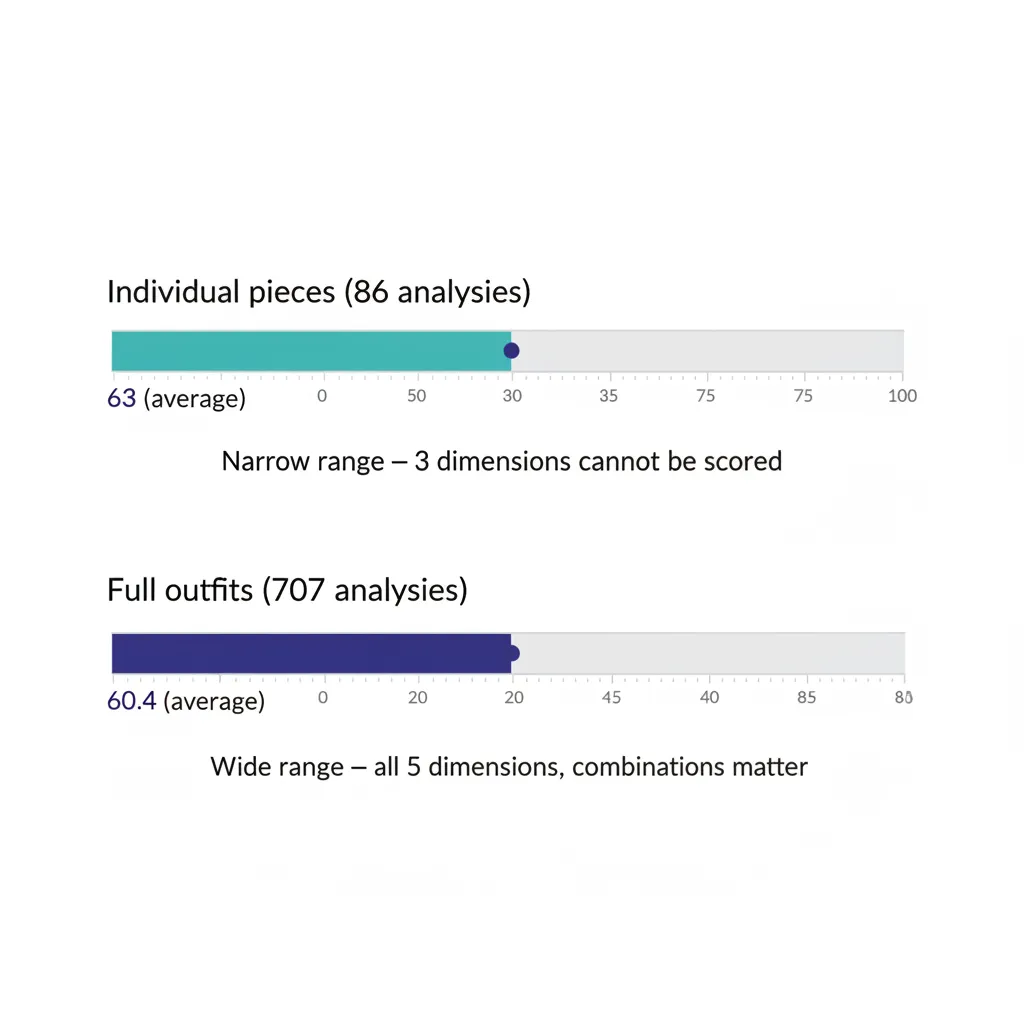
Individual pieces score in a narrow band because three dimensions can't be evaluated. Full outfits span a much wider range because outfit combinations can compound quality — or cancel it.
The Best Use Cases for Individual Piece Analysis
Based on the OutfitScore database, individual piece analyses are used productively in these specific scenarios:
Before buying online, upload the product photo and get a quality and design assessment. The AI evaluates whether the garment itself is well-made and well-designed, independent of how you would style it.
Systematically photograph items you own to get an honest quality assessment. Items scoring below 55 on individual piece analysis are typically low-construction or low-design-quality pieces that are unlikely to significantly elevate any outfit they appear in.
For a piece with an unusual colour or pattern, individual analysis can assess whether the colour itself is well-executed and versatile — before you decide how to style it in an outfit context.
Shoes photographed can be assessed for construction quality, design integrity, and material type — useful when buying online where product photos can be misleading about actual quality.
When to Stop and Upload the Full Outfit
Individual piece analysis answers "is this a good garment?" If the question is "does this work in my wardrobe?" or "will this look good on me?" or "does this outfit work for my date tonight?" — the full outfit upload is the only format that answers it accurately.
The data shows that items scoring 65 on individual analysis can anchor outfits scoring 78 (when paired well) or 48 (when paired poorly). The individual piece score has no predictive power over the outfit score because it cannot see the other pieces. The outfit score — the one that accounts for colour harmony, styling cohesion, and actual occasion context — is the only number that tells you whether your look for tonight actually works.
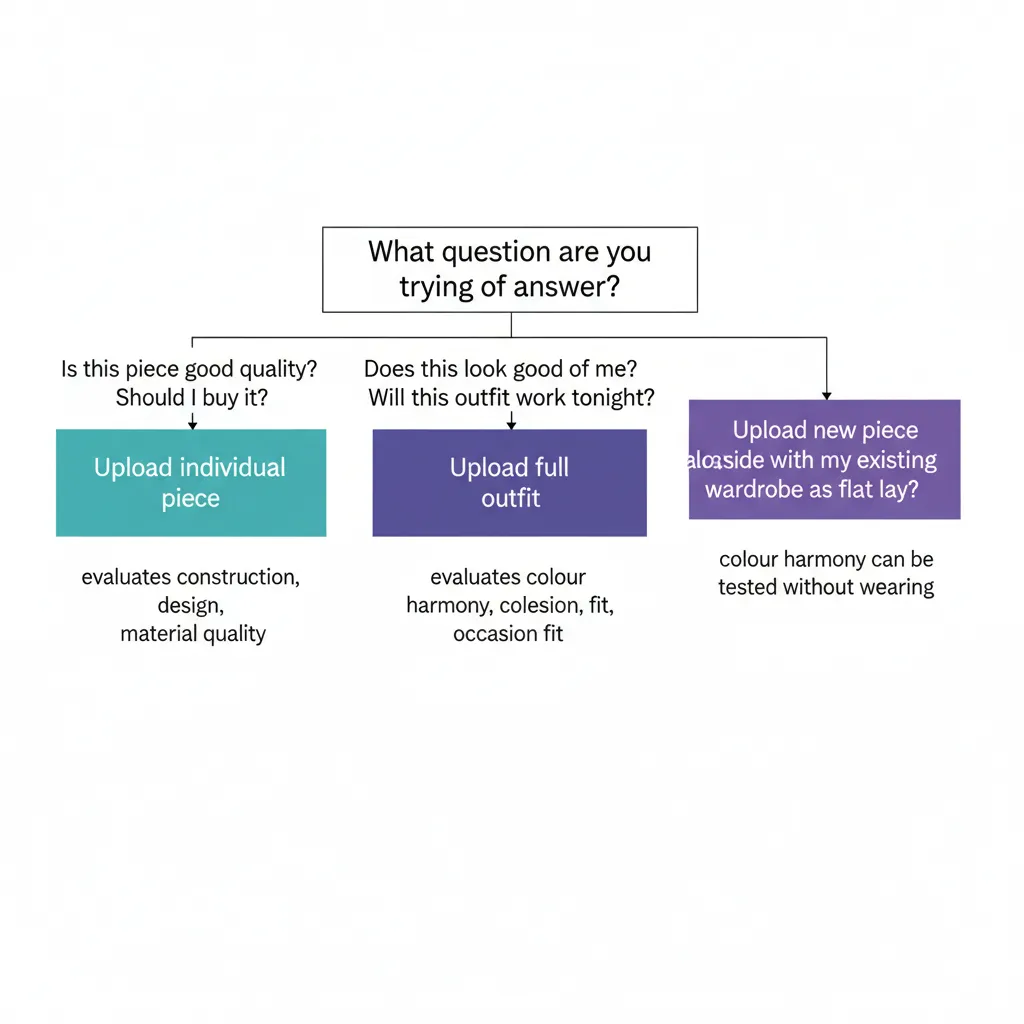
The question you're trying to answer determines the format. Quality question → individual piece. Style question → full outfit.
Six piece-vs-outfit scores from the same garments
The individual number answers "is this a good garment?" The outfit number answers "does this work tonight?" These six pairs are the same item in both formats.
Navy blazer alone 71 / worn with white tee, dark jeans, tan loafers 82
Context added colour harmony and occasion. The blazer did not get better. The outfit did.
Same navy blazer alone 71 / worn with a graphic hoodie and running shorts 48
The piece score stayed 71. The outfit cancelled it. Individual analysis cannot warn you about this pairing because it never sees the hoodie.
White leather sneaker pair 68 / full streetwear look 76
Shoes photographed alone are a construction check. On-body they pick up colour harmony with the rest of the palette and usually gain 6–10 points when the outfit is planned.
Unusual print shirt 64 / worn with clashing patterned trousers 41
The shirt's own colours were fine. Against a second print they failed cohesion. Upload the shirt alone to decide if it is worth keeping; upload the outfit to decide if you can wear it tonight.
Budget knit 57 / worn in a two-colour palette with tailored trousers 74
A modest piece can still anchor a high outfit when the other four dimensions are strong. Do not throw out a 57 knit because the piece score looks average.
Designer coat 72 / worn over loungewear and slides 39
Quality does not survive context. The coat's construction score is real. Occasion-appropriateness of the full look overrode it. This is why purchase-decision uploads and going-out uploads must stay separate.
If you only have time for one photo, wear the outfit. The 86 piece analyses in the database are useful for shopping. The 707 full-outfit analyses are useful for getting dressed. They are not interchangeable numbers.
Get the right score for the right question
Upload a single piece for a quality assessment, or your full outfit for a complete outfit check and style analysis. Both are free.
Rate My Outfit Free →Frequently Asked Questions
Can AI rate a single clothing item?
Yes — OutfitScore analyses individual pieces and scores quality, construction, design, and styling potential. Three of the five full dimensions (colour harmony with other pieces, styling cohesion, and occasion-appropriateness of the full look) cannot be evaluated without outfit context.
Do individual pieces score higher or lower than full outfits?
Individual pieces score in a narrower range — typically 55–72 — because three dimensions are missing. Full outfits span 20–88+ because all five dimensions are evaluated and combinations can compound quality or cancel it out.
What does AI look for when rating a single clothing item?
Primarily garment quality (fabric, construction), design coherence (proportions, pattern quality), and styling versatility potential. It is a quality and design assessment rather than a styling assessment.
Should I upload individual pieces or the full outfit?
Upload the full outfit for actionable style feedback. Individual piece scoring is useful for quality assessment and purchase decisions — but the full outfit score shows how the combination actually works, which is where improvement opportunities exist.
Can a high-scoring piece still tank a full outfit?
Yes. A blazer that scores 71 alone has landed at 48 in a badly assembled outfit and 82 when the rest of the look was planned. The individual score cannot predict the outfit score.
When should I still upload a single item?
Use a single-item upload for a purchase decision, a wardrobe audit of construction quality, or a colour check on an unusual print. If the question is "will this work tonight?", wear the full outfit.
About the Author: Saad Sellami
Saad is the Founder and Lead Data Analyst at OutfitScore. With a background in software engineering, he analyzes tens of thousands of AI fashion assessments to uncover data-driven insights into how we dress, color theory, and styling patterns. Read more about the OutfitScore mission →