Why Most People Score 50–67 on AI Outfit Raters — And How to Break 70
The 50–67 range is where most outfit scores land. Not because people dress badly — but because their outfits are functional without being intentional. Here's the exact data on why this happens, which five sub-scores are responsible, and what actually moves the needle.
Disclosure: Some links in this article are affiliate links. As an Amazon Associate, OutfitScore earns from qualifying purchases, at no extra cost to you.
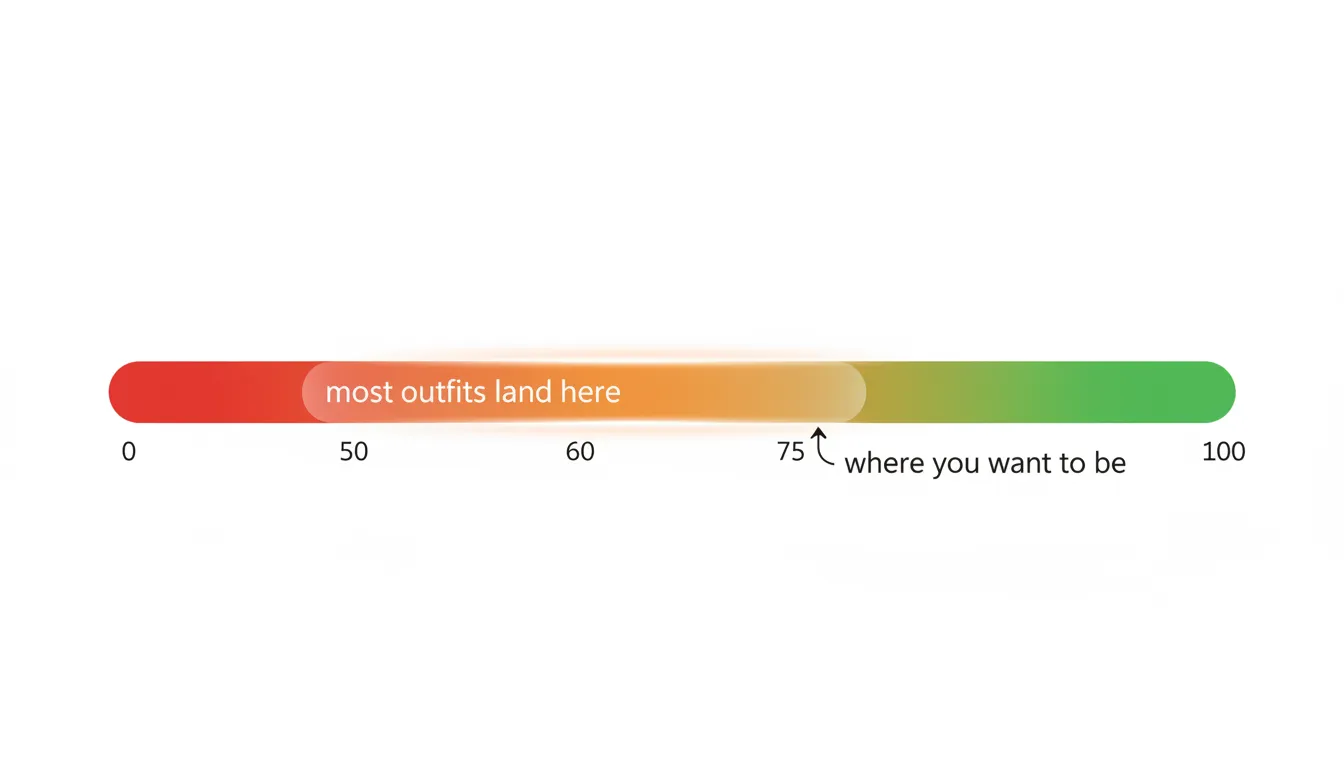
The 50–67 range is where functional-but-unstyled outfits cluster. Breaking out of it requires addressing specific sub-scores — not buying better clothes.
Advertisement
The average outfit score across thousands of AI analyses sits at 60.4 out of 100. The 25th percentile is 56. The 75th percentile is just 67. That means three-quarters of all analysed outfits score between 56 and 67 — a remarkably tight band.
This isn't a coincidence. This range is the natural resting place of outfits that are appropriate, clean, and colour-coherent, but lack the intentional details that push a score into the 70s. The clothes are fine. The styling is unfinished.
Understanding why requires looking at the five sub-dimensions AI uses to score an outfit — and specifically which two are the weakest.
Advertisement
The Five Sub-Scores — and Where Most Outfits Lose Points
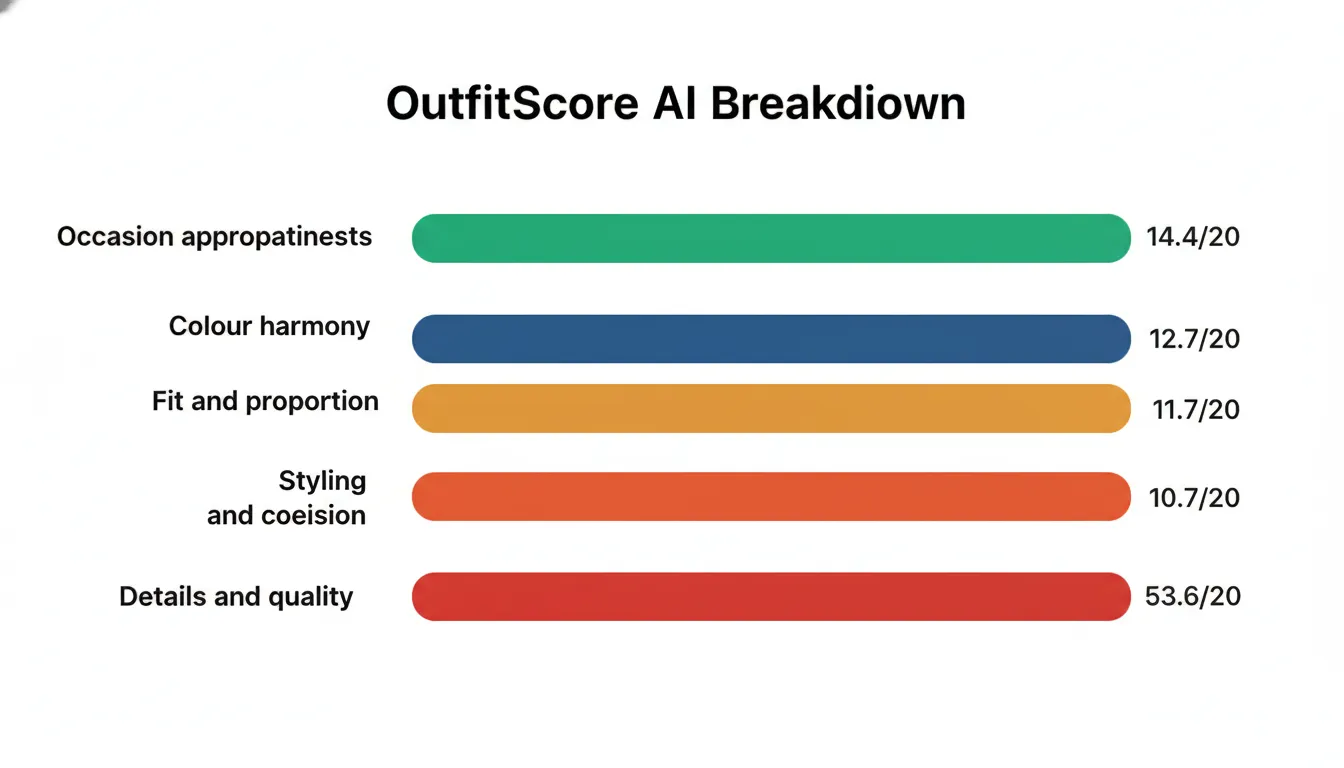
The gap between your highest sub-score (occasion appropriateness) and your lowest (details and quality) is nearly 4 full points — and that gap is where your overall score gets dragged down.
1. Occasion Appropriateness — 14.4/20 (Your Strongest)
Most people dress reasonably well for the context they're in. Casual everyday outfits look casual. Work outfits look professional enough. This is your highest-performing sub-score because it requires the least fashion knowledge — just basic social awareness. It's also the hardest to improve because it's already near its ceiling for casual wear.
2. Colour Harmony — 12.7/20
Most people intuitively avoid obvious colour clashes — not wearing neon orange with hot pink. But colour harmony goes deeper than that. AI evaluates whether the colour palette is intentional: is there a clear dominant colour? Are the neutrals complementing or competing? Is the footwear colour disconnected from the rest of the palette? The most common failure here is grey sneakers with a burgundy-and-black outfit — each piece is fine alone, but the grey has no relationship to the rest of the look.
3. Fit and Proportion — 11.7/20
This is where oversized clothing costs you the most. Oversized doesn't automatically mean stylish — it depends entirely on the silhouette intention. A deliberately oversized top with fitted trousers is intentional. An oversized top with loose jeans and bunching at the hem is shapeless. The AI reads the second as a proportion failure. Most casual outfits in the data feature some version of this: an untucked shirt over loose jeans, creating a rectangular, waistless silhouette that scores around 11–12 out of 20.
The oversized trap
"The oversized sweater creates a shapeless silhouette that lacks intentional structure." — Direct AI feedback from multiple outfit analyses. The word intentional appears repeatedly. AI doesn't penalise oversized. It penalises oversized without structure.
4. Styling and Cohesion — 10.7/20 (Second Worst)
Cohesion is about whether the outfit looks like it was composed by one person with one vision, or assembled from separate random decisions. The single biggest driver of low cohesion scores is missing accessories. An outfit with three correct garments but no accessories reads as "three separate items" rather than "one look." Adding a chain necklace, belt, or watch doesn't just add a piece — it adds an editorial decision that unifies the whole outfit in the AI's scoring model.
5. Details and Quality — 10.6/20 (The Lowest)
This is the most overlooked and hardest-to-fix sub-score. It evaluates fabric texture, garment condition, print quality, and material presentation. A graphic sweatshirt with a dated print, denim with an uninspiring wash, or a shirt with visible wrinkles all drag this score down. This sub-score responds less to styling tricks and more to actual garment investment — choosing clothes with some textural interest (a ribbed knit, a subtle check, a quality plain tee) over purely logo-heavy or print-heavy pieces.
The Exact Path From 60 to 70
Breaking 70 doesn't require a new wardrobe. It requires addressing the two lowest sub-scores simultaneously — styling and cohesion, and fit and proportion. Here's the most efficient route:
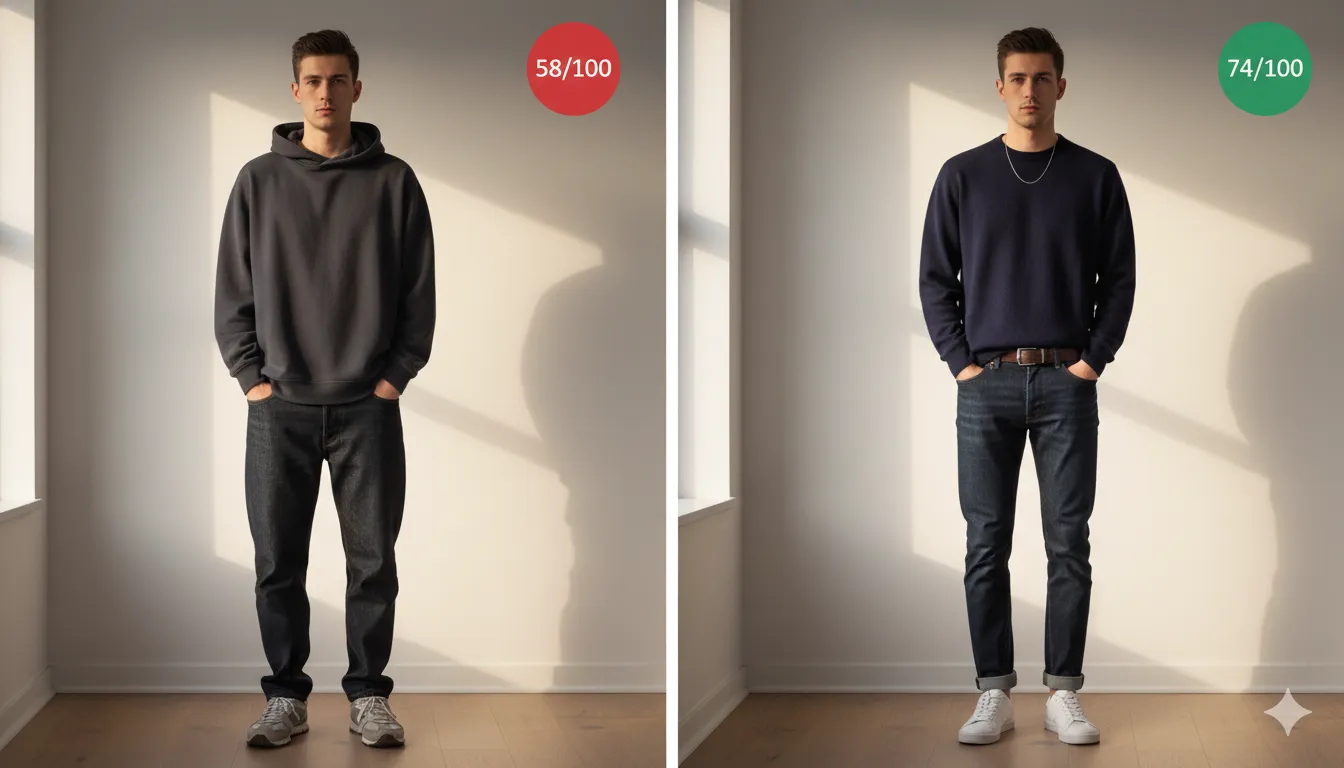
From 58 to 74 — the same bottom half, the same sneakers. The change: a French tuck, a chain necklace, and a belt. All three cost under £30 combined.
Either define your waist through a French tuck or add a leather belt. Both create a waist marker that lifts the fit sub-score. Average improvement: +3–5 points on that dimension alone.
A silver chain necklace, minimalist watch, or gold hoop earrings. This single addition raises the cohesion score by signalling that the outfit was composed with intent. Average improvement: +3–4 points.
Dirty or scuffed sneakers actively lower the quality sub-score. Clean white leather sneakers or well-maintained Chelsea boots signal care — which AI reads as effort. Average improvement: +2–3 points.
These three changes together address all three of the weakest sub-scores simultaneously. The result is a jump from the 58–64 range to the 70–76 range — without spending anything on new clothes beyond a £10 chain or £15 belt.
What Scoring 75+ Actually Requires
The top 10% of scored outfits sit in the 75–84 range. Getting there requires not just fixing the weak sub-scores, but actively improving the details and quality score — which means making different garment choices, not just styling tricks.
Outfits that score in the 75–84 range share these characteristics: they contain at least one textural contrast (a smooth fabric paired with a matte or ribbed one), they have zero visible graphic prints as the primary garment, their colours are clearly intentional (a 2–3 colour palette with defined dominant and accent), and they include at least two accessories that feel coordinated with each other.
Breaking 85 is extremely rare. Across thousands of analyses in the dataset, fewer than 0.5% of outfits achieved it. These are editorial-level looks — professional styling, perfectly coordinated accessories, high-quality fabrics, and a coherent aesthetic that's distinctly personal. It's achievable, but it requires genuine styling sophistication rather than quick fixes.
Find out exactly which sub-score is holding you back
Upload your outfit and get a full breakdown of all five dimensions — with specific tips to fix your lowest score. Free.
Get My Outfit Score →Frequently Asked Questions
What is a good outfit score on AI outfit raters?
The average score is around 60. A score of 70–74 puts you in the top quarter of users. 75–84 is excellent. Scoring 85+ is achieved by fewer than 0.5% of outfits — those are genuinely editorial-quality looks.
Why does my outfit score stay below 65?
The most common reason is low scores on styling and cohesion (avg 10.7/20) and details and quality (avg 10.6/20). Both are driven by missing accessories, lack of textural variety, and shapeless proportion. These are fixable without buying new clothes.
Does an expensive outfit always score higher?
No. A styled £30 outfit outscores an unstyled £300 outfit. The AI evaluates intentionality and composition, not price tags or brand labels.
How is the outfit score calculated?
OutfitScore's AI evaluates five dimensions: colour harmony, fit and proportion, details and quality, styling and cohesion, and occasion appropriateness. Each is scored out of 20, and the sum gives your score out of 100.
About the Author: Saad Sellami
Saad is the Founder and Lead Data Analyst at OutfitScore. With a background in software engineering, he analyzes tens of thousands of AI fashion assessments to uncover data-driven insights into how we dress, color theory, and styling patterns. Read more about the OutfitScore mission →