You're 17 Points Away From Your Best Outfit: Here's What's Holding You Back
Every time OutfitScore analyses your photo, it shows you two numbers: your current score, and your potential score. The gap between those two numbers averages 17.5 points across thousands of analyses. This article explains what lives in that gap — and how to close it.
By Saad Sellami, Founder
By Saad Sellami, Founder & Data Analyst
Published: April 21, 2026
Reading time: 7 minutes
Disclosure: Some links in this article are affiliate links. As an Amazon Associate, OutfitScore earns from qualifying purchases, at no extra cost to you.
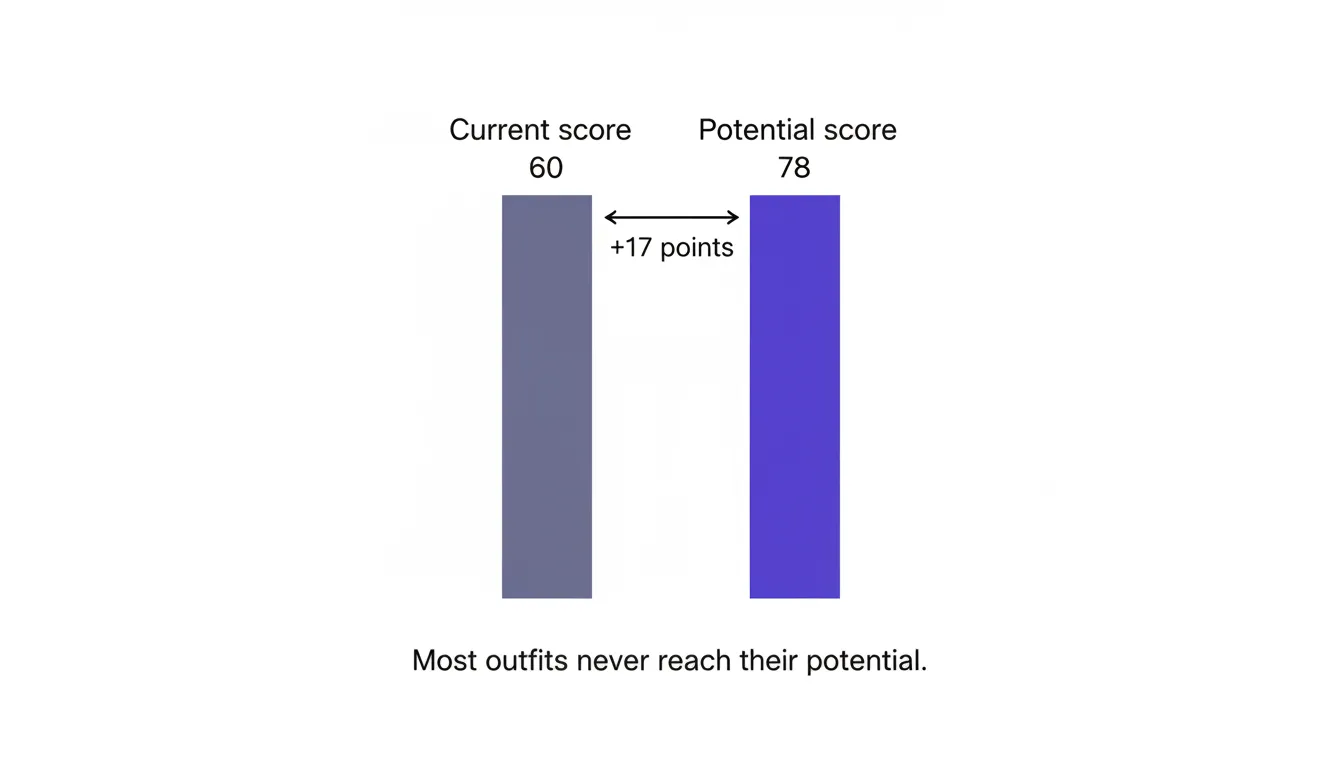
The average current outfit score is 60.4. The average potential score is 77.6. That 17-point gap doesn't require a new wardrobe to close.
Advertisement
When AI analyses an outfit, it does two things: it evaluates what it sees right now, and it calculates what that same outfit could score with the specific changes listed in the quick wins and improvement tips. The first number is your current score. The second is your potential score.
The potential score is not a fantasy. It's not "if you bought a whole new wardrobe." It's the score your current clothes — in their current state — would achieve if you applied the improvements the AI explicitly names. That means the gap between your current and potential score is entirely closeable with what you already have.
Across thousands of analyses, the average gap is 17.5 points: from a current average of 60.4 to a potential average of 77.6. This article breaks down what lives in that gap.
Advertisement
What the 17-Point Gap Is Made Of
The gap is not random. It's composed of highly specific, recurring improvements that appear across the majority of outfit analyses. Three categories account for the vast majority of it:
These three changes together account for roughly 17 points of potential improvement — which maps almost exactly to the average gap in the data. They're not coincidental. They're the three most common AI recommendations, appearing across the majority of all analyses regardless of gender, style, or occasion.
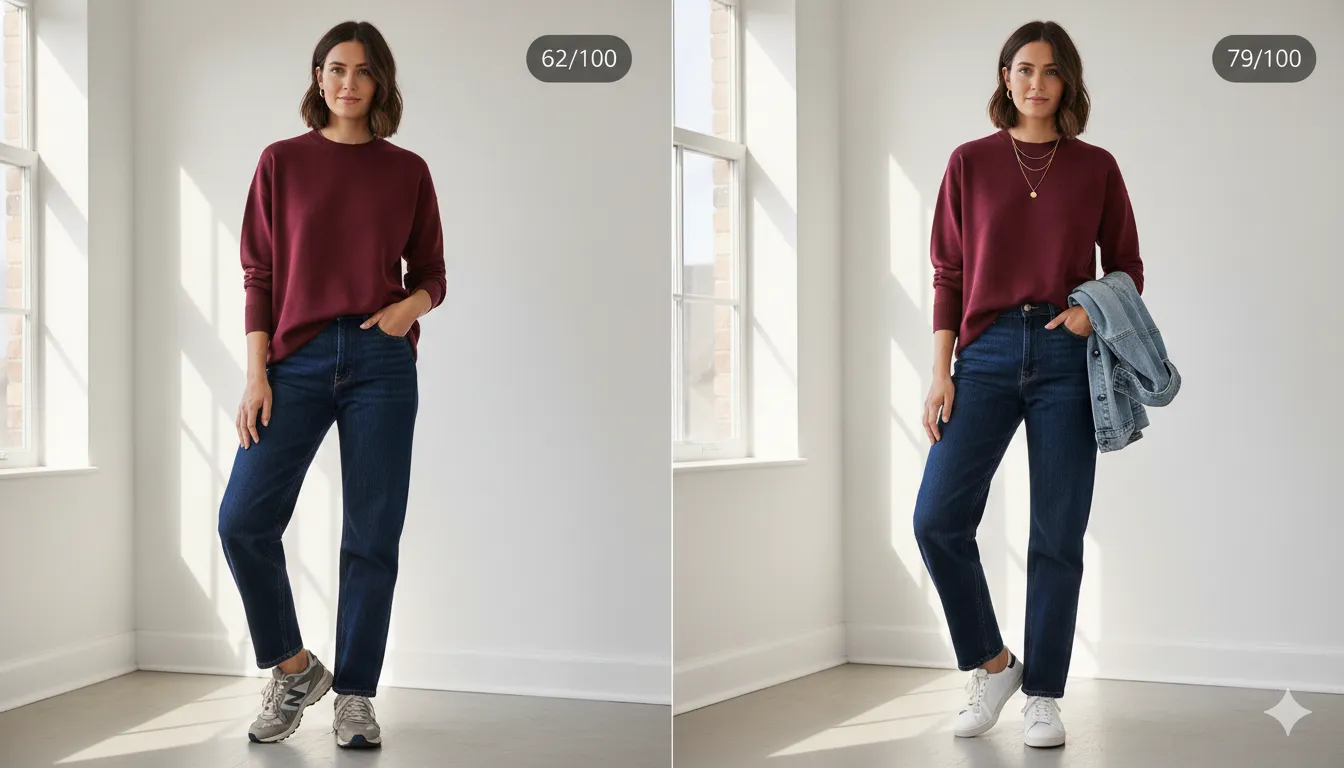
From 62 to 79. Same sweater, same jeans. What changed: a French tuck, gold necklace, gold hoops, clean white sneakers, and a denim jacket on arm. Total additional spend: approximately £25.
Why the Gap Persists
If the fixes are this specific and this achievable, why does the gap persist across thousands of analysed outfits? Two reasons:
First, people don't know what the gap is made of. They know their outfit isn't quite right. They don't know it's a missing silver chain necklace and a French tuck. Without that specificity, the default response is to either keep wearing the outfit as-is or buy new clothes — neither of which closes the actual gap.
Second, the gap feels bigger than it is. Most people see a score of 62 and think the problem is fundamental — wrong style, wrong body, wrong clothes. But 62 to 78 is not a different wardrobe. It's three specific adjustments to the existing one. The potential score exists precisely to make this concrete: your clothes are capable of 78. You just haven't styled them to 78 yet.
The potential score is based on your actual clothes
The AI calculates your potential score using the garments you already have in the photo — not theoretical new purchases. If the potential score is 78, that means your current clothes are capable of 78. The gap is in the styling, not the wardrobe.
How to Close Your Specific Gap
The gap varies between people. Some people are 10 points away — their outfit is mostly there, just needs one accessory. Others are 25+ points away — a shapeless silhouette, wrong footwear, and no accessories all at once. The path to closing it is specific to your analysis, not generic.
The quick wins listed in your OutfitScore analysis are in priority order — the first quick win has the highest individual score impact. The areas for improvement are ranked by how much they contribute to your gap. The shopping recommendations include explicit score impact numbers so you know exactly how many points each change is worth.
The most efficient path for most people is to address the first two quick wins before anything else. Across thousands of analyses, the first quick win alone accounts for an average of 6–8 points of potential improvement. That's often half the gap, solved by one change.
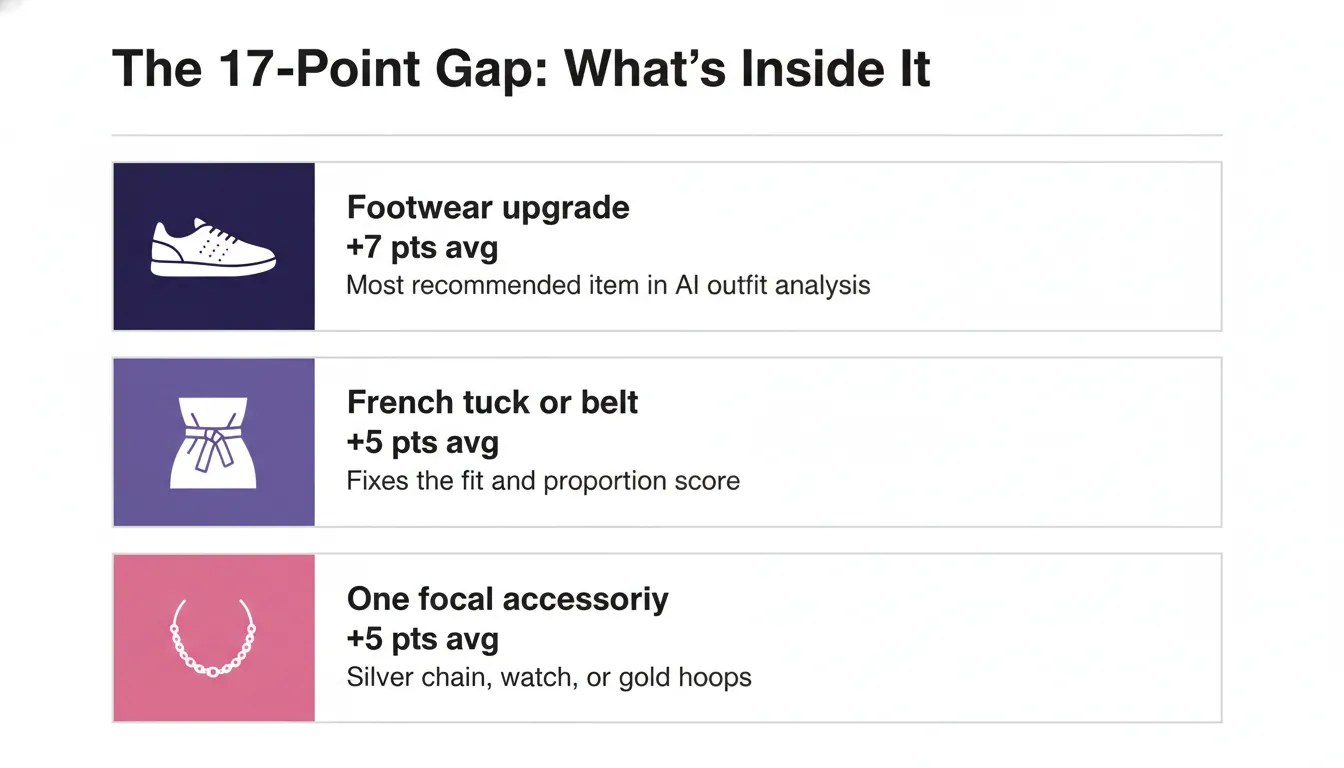
Three specific changes. Seventeen points. The gap is structured, not random — and that makes it closeable.
When the Gap Can't Be Closed by Styling Alone
There are cases where the potential score is capped lower than 78 — usually around 70–72. This happens when the garments themselves have a quality ceiling: graphic prints with a dated aesthetic, heavily worn fabrics, or a colour combination that's actively clashing rather than neutrally mismatched.
In these cases, the AI still recommends styling improvements, but it also explicitly suggests garment replacements — usually one piece, not the whole outfit. The most common replacement recommendation is the primary top: swapping a graphic sweatshirt for a solid-colour crewneck, or replacing a dated-wash denim jacket with a cleaner version. These are usually single-item purchases that unlock the potential the rest of the outfit already has.
Find out your current gap — and exactly how to close it
Upload your outfit and see your current score, your potential score, and the exact changes that get you there. Free.
See My Potential Score →Frequently Asked Questions
What is a potential outfit score?
The potential score is the score your current outfit could achieve if you applied all the recommended improvements. It's calculated based on your actual clothes — not theoretical new purchases. If it says 78, your current wardrobe is capable of scoring 78.
How is the potential score different from the current score?
Your current score reflects what the AI sees right now. Your potential score reflects what the same garments would score with the styling improvements applied — French tuck, added accessories, corrected footwear. The average gap is 17.5 points.
Can I close the gap without buying new clothes?
In most cases, yes. The majority of the gap comes from styling choices — not garment quality. Adding a chain necklace, French-tucking your shirt, and wearing clean footwear are the top three fixes across all analyses, and most people already have access to at least two of them.
What if my gap is more than 20 points?
A gap over 20 points typically means multiple issues at once: missing accessories, a shapeless silhouette, and incorrect footwear. Work through the quick wins in order — addressing the first one alone usually closes 6–8 points of the gap immediately.
About the Author: Saad Sellami
Saad is the Founder and Lead Data Analyst at OutfitScore. With a background in software engineering, he analyzes tens of thousands of AI fashion assessments to uncover data-driven insights into how we dress, color theory, and styling patterns. Read more about the OutfitScore mission →