The Accessory Gap: Why 90% of Outfits Are Missing the Same Thing
After analysing thousands of real outfit photos with AI, one pattern showed up in nearly every single look — not wrong colours, not bad fit, not ugly clothes. Missing accessories. Here's what the data shows, and exactly which pieces fix it.
By Saad Sellami, Founder
By Saad Sellami, Founder & Data Analyst
Published: April 21, 2026
Reading time: 7 minutes
Disclosure: Some links in this article are affiliate links. As an Amazon Associate, OutfitScore earns from qualifying purchases, at no extra cost to you.
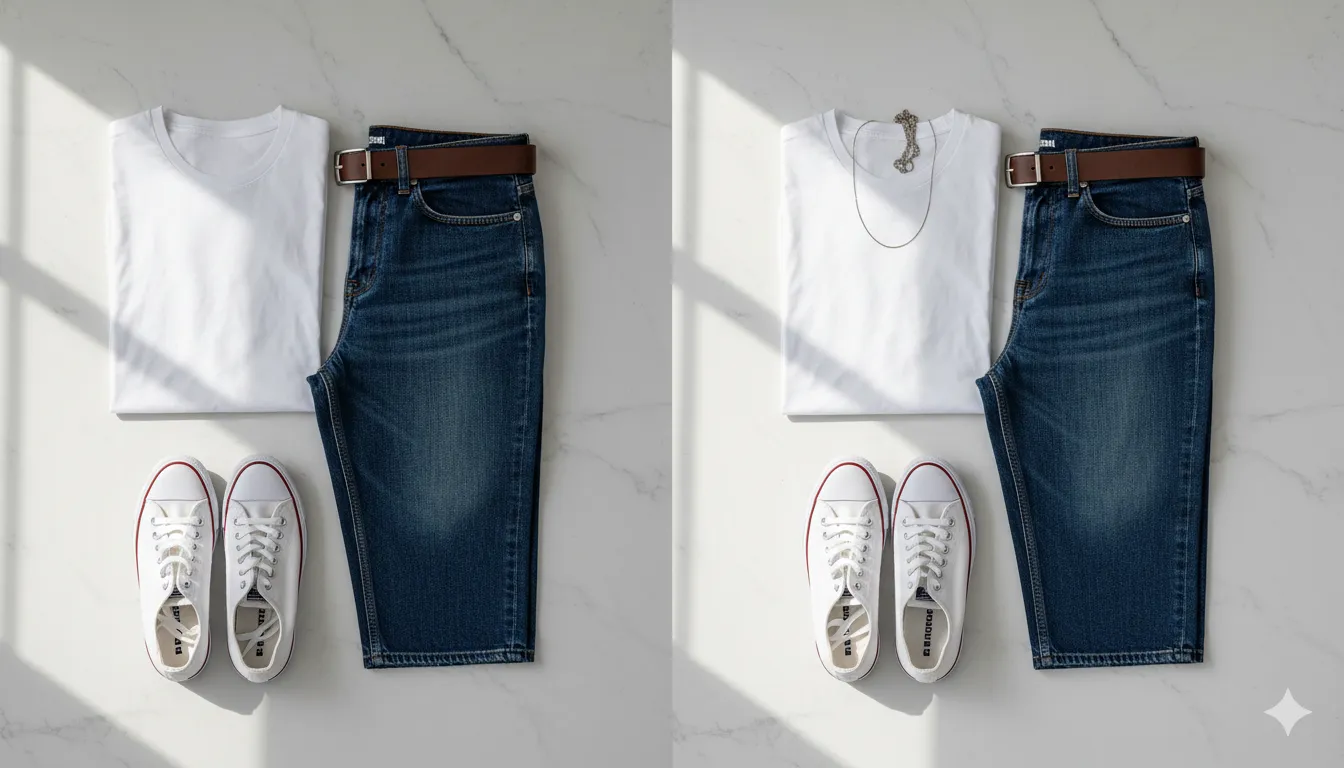
Same clothes. Same colours. The difference is three accessories — and about 12 outfit score points.
Advertisement
When AI analyses your outfit, it scores five dimensions: colour harmony, fit and proportion, details and quality, styling and cohesion, and occasion appropriateness. The weakest two — styling and cohesion (avg 10.7/20) and details and quality (avg 10.6/20) — are almost entirely driven by one thing: the presence or absence of intentional accessories.
The clothes you own are not the problem. The problem is that you're leaving them unfinished. An outfit without accessories is like a sentence without a full stop — technically there, but something is clearly missing.
What "lack of accessories" costs you
- • Styling & cohesion sub-score drops by an estimated 3–5 points
- • Outfit score often stays stuck below 65
- • The look reads as "random basics" rather than a curated outfit
- • AI flags it as lacking intentionality — the single harshest verdict
Advertisement
The Top 5 Missing Accessories (Ranked by Score Impact)
Not all accessories are equal. AI outfit scoring assigns score impact values to each recommendation. Here's what the data shows, ranked from highest to lowest average score impact.
1. Clean Footwear — +7 Points Average
Footwear is the single highest-scoring accessory category in AI analysis — recommended in more analyses than any other category. The specific item recommended most often? White leather low-top sneakers — clean, minimal, and universally compatible with casual, streetwear, and smart-casual looks.
The second most recommended is leather Chelsea boots — for when the outfit needs elevation rather than freshness. The key insight from the data: it's not about the brand or price. It's about whether the shoe looks clean and intentional. Scuffed or dirty sneakers actively drag the quality sub-score down even when the rest of the outfit is strong.
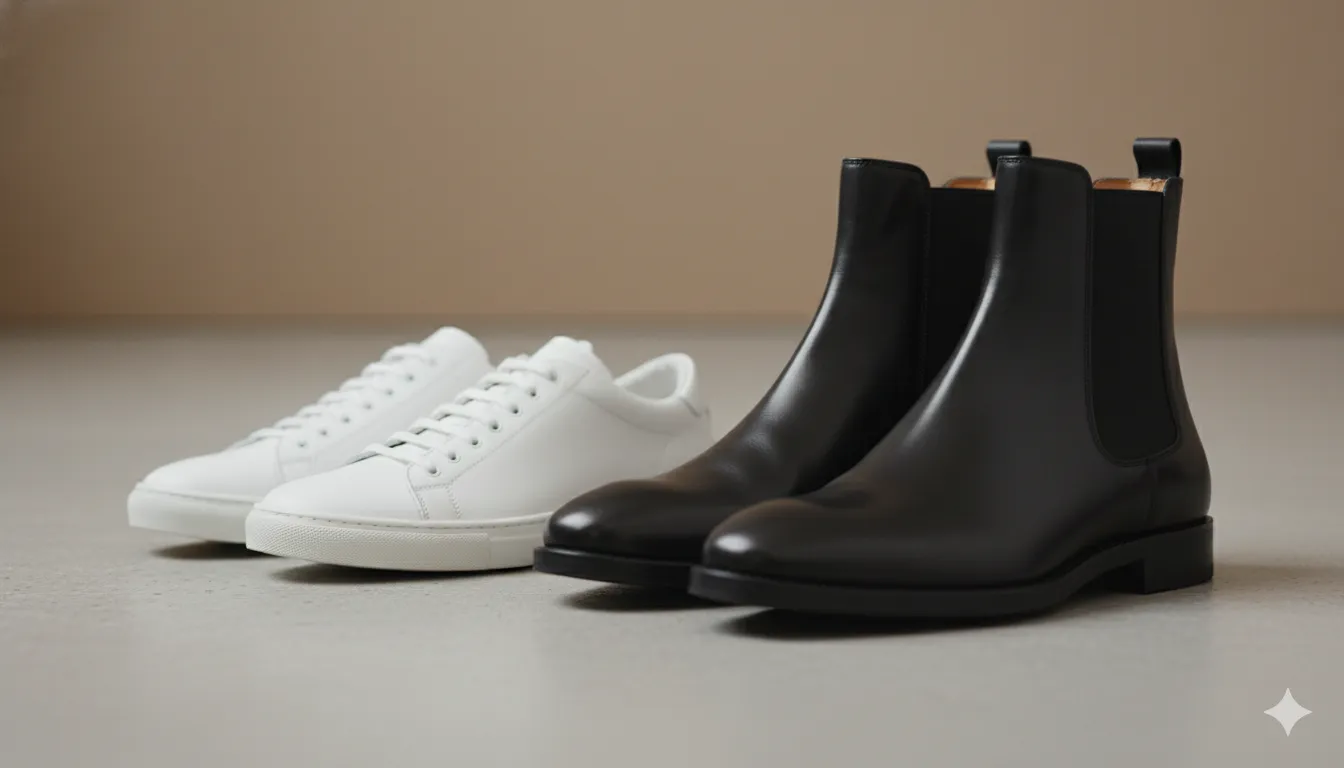
White leather sneakers and Chelsea boots are the two footwear choices that add the most score points across all outfit types.
2. Silver Chain Necklace — +5 Points Average
The silver chain necklace is the most recommended jewellery item across thousands of AI outfit analyses. Not a pendant, not a chunky chain — a simple, slim silver chain worn at mid-collar length. It draws the eye upward toward the face, breaks the monotony of a plain top, and adds a subtle intentionality that AI rewards under "details and quality." For women, gold hoop earrings appear as the equivalent recommendation — simple, versatile, and immediately elevating.
3. Minimalist Watch — +5 Points Average
A minimalist leather or metal watch frequently appears as a recommended accessory for male-presenting outfits. The score impact is identical to a chain necklace — around 5 points — but the reasoning differs. A watch signals effort without trying hard. It breaks up the sleeve line, adds a focal point to the wrist area, and reads as "put-together" rather than "dressed up." The AI specifically recommends it for outfits that are stylistically complete but feel flat.
4. Leather Belt — +5 Points Average
The leather belt is the most functional accessory in the data — it doesn't just decorate, it structures. When an outfit scores low on fit and proportion (avg 11.7/20), a belt is often the simplest fix. It defines the waist, prevents the top-to-bottom transition from looking shapeless, and provides a colour anchor point. The AI most commonly recommends a slim brown leather belt for casual outfits and a black leather belt for smart-casual or monochromatic looks.
5. Cropped Denim Jacket — +7 Points (Layering)
The denim jacket is the most recommended outerwear/layering piece in the data. It adds texture, structure, and a second visual layer to outfits that read as too simple. It's effective precisely because it's not trying too hard — it elevates a basic outfit without making it look overdressed. A cropped or standard-length denim jacket over a plain tee is one of the highest-scoring simple layering combinations in the dataset.
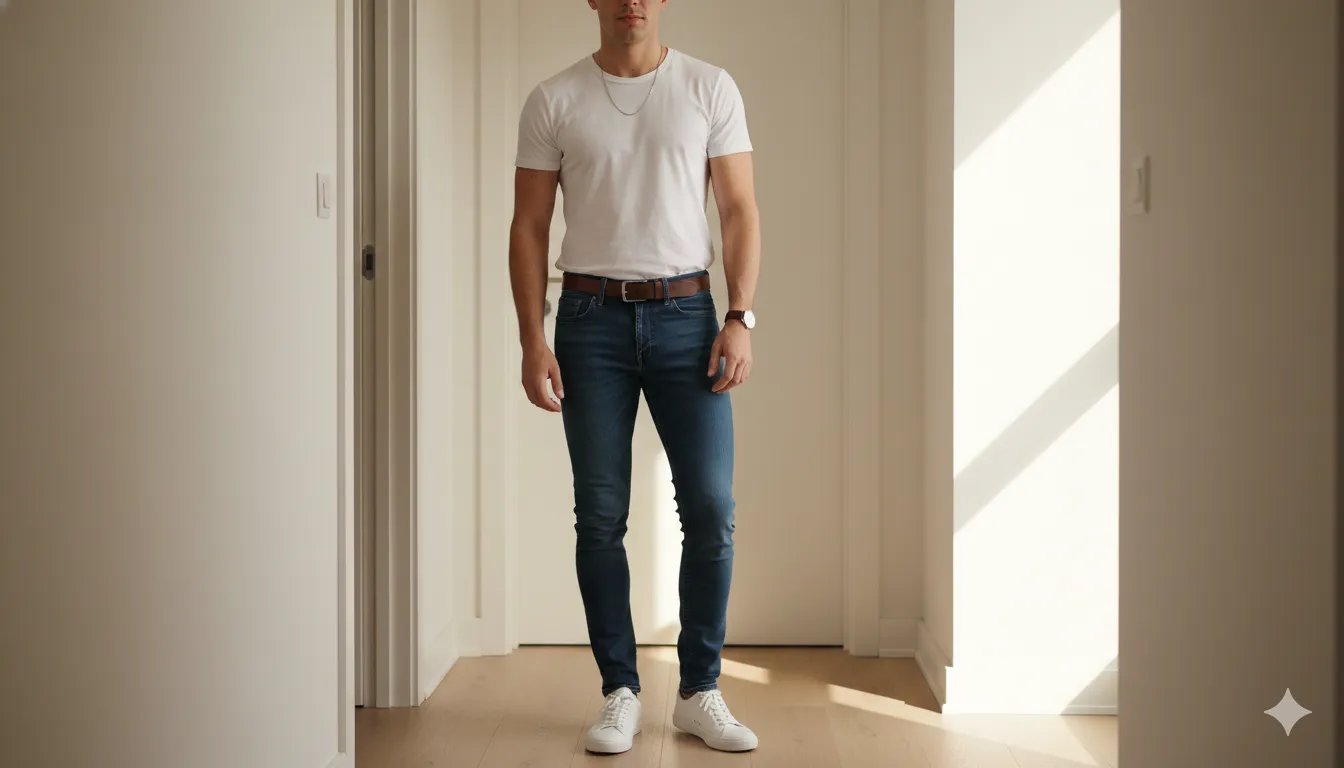
A white tee and dark jeans is one of the most common outfits in the data. The chain, watch, and belt are what push it from a 58 to a 75.
Why Accessories Score Higher Than Better Clothes
This is the counterintuitive insight from the data: buying better clothes rarely fixes a low outfit score as efficiently as adding the right accessories. Here's why.
The AI evaluates outfits on intentionality — does this look like someone thought about it? A £20 white t-shirt with a silver chain, leather belt, and clean sneakers reads as more intentional than a £120 designer hoodie worn alone with no accessories. The accessories signal that a human made choices. The hoodie alone signals someone grabbed whatever was on the chair.
This also explains why the styling and cohesion sub-score (10.7/20 average) is the second-lowest in the dataset. Cohesion doesn't come from matching brand labels. It comes from deliberate decisions — and accessories are the easiest way to show those decisions to the eye.
The 3-accessory rule
For any casual or smart-casual outfit, aim for exactly three accessories:
The Accessories That Don't Help (And Why)
Not all accessories improve your score. The AI explicitly flags certain accessory choices as score-negative in the data:
- Event-branded merchandise — "Avoid using event-branded merchandise as a primary accessory" is a direct AI style warning in the data. Tour shirts, festival lanyards, and team jerseys read as unintentional.
- White belts — Specifically flagged as "acting as a harsh divider that shortens the torso and breaks the outfit's continuity." The belt colour should match either your shoes or your top, not contrast against both.
- Fuzzy slides — Explicitly described in AI analysis as "strictly indoor footwear." Wearing them outdoors signals a complete absence of styling consideration.
- Too many competing focal points — A chunky chain, three rings, bold earrings, and a statement bag all at once creates "visual fatigue" — the AI flags this as a cohesion issue, not a style flex.
See exactly which accessories your outfit is missing
Upload a photo of your jewelry, bags, or shoes and get specific coordination recommendations with score impact numbers — free.
Score My Outfit — FreeFrequently Asked Questions
What accessories add the most points to an outfit score?
Based on AI analysis of thousands of real outfits, the highest-impact additions are clean footwear (+7 pts avg), a silver chain or gold hoops (+5 pts), a minimalist watch (+5 pts), and a leather belt (+5 pts). Footwear is the single highest-return investment.
How many accessories should I wear?
For casual and smart-casual looks, aim for three: one focal piece (jewellery or watch), clean intentional footwear, and one structural piece (belt or jacket). More than three can tip into visual overload and lower your cohesion score.
Do accessories help streetwear and athleisure outfits?
Yes — these are actually the style categories where accessories have the most impact, because the base clothes are often the same as everyone else's. A chain and clean sneakers are what separates a 60-scoring streetwear look from a 75-scoring one in the data.
Can I check how accessories affect my outfit score?
Yes. Upload your outfit on the free AI outfit rater and get AI feedback on coordination, proportion, and what's missing — with specific item recommendations.
About the Author: Saad Sellami
Saad is the Founder and Lead Data Analyst at OutfitScore. With a background in software engineering, he analyzes tens of thousands of AI fashion assessments to uncover data-driven insights into how we dress, color theory, and styling patterns. Read more about the OutfitScore mission →