Occasion Appropriateness: The Easiest AI Outfit Score to Max Out (14.4/20 Average)
Of the five dimensions OutfitScore's AI outfit rating evaluates, occasion appropriateness scores the highest — averaging 14.4 out of 20 across thousands of analyses in our database. That's nearly 4 points above the next strongest dimension. Here's why most people already score well here, what makes it collapse completely, and how to push it from "appropriate" to genuinely impressive.
Disclosure: Some links in this article are affiliate links. As an Amazon Associate, OutfitScore earns from qualifying purchases, at no extra cost to you.
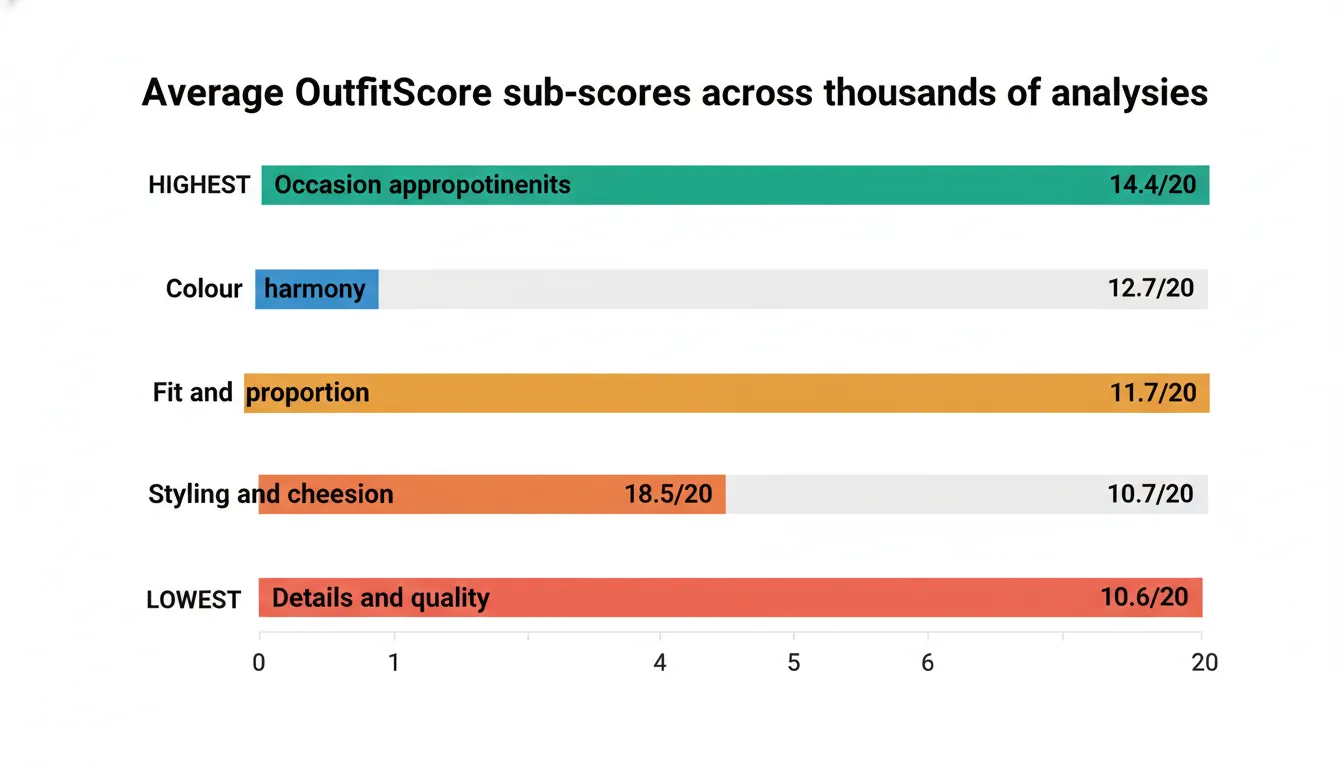
Occasion appropriateness (14.4/20) outperforms every other dimension in the OutfitScore database by a significant margin. Most people dress contextually appropriately — they just don't do much else well.
Advertisement
Occasion appropriateness is the dimension that requires the least fashion knowledge and the most social context awareness. The AI evaluates it by asking: does this outfit belong in the setting it is photographed in, or intended for? Most people, without any styling training, can answer this question reasonably well — they don't wear black tie to the gym, or gym clothes to a job interview. This basic contextual instinct is what produces the 14.4/20 average.
The two dimensions dragging overall scores down — details and quality (10.6/20) and styling and cohesion (10.7/20) — require actual fashion knowledge to improve. Occasion appropriateness does not. It requires awareness of social context, which most people already have.
Advertisement
What "Appropriate" Looks Like at Each Score Level
The outfit doesn't just avoid being wrong — it actively signals awareness of the occasion. A job interview outfit that shows business-casual confidence rather than just "not casual." A date night outfit that communicates effortful dressing rather than just "no gym clothes." The AI rewards the positive signal, not just the absence of a negative one.
The outfit is appropriate for the context without actively demonstrating occasion-awareness. A casual outfit for a casual setting. An office-appropriate outfit for a general business environment. This is where the database average (14.4/20) sits — it's fine, not impressive.
The outfit is technically appropriate but contains elements that create tension — too casual for the context implied by one or two pieces, or too formal for an otherwise casual setting. The AI flags the inconsistency without a hard penalty.
Full context mismatch — loungewear in a public setting, indoor footwear outside, pajamas presented as an outfit. The AI explicitly flags these: "This look is strictly limited to domestic environments." These are the cases that pull averages down and produce style warnings.
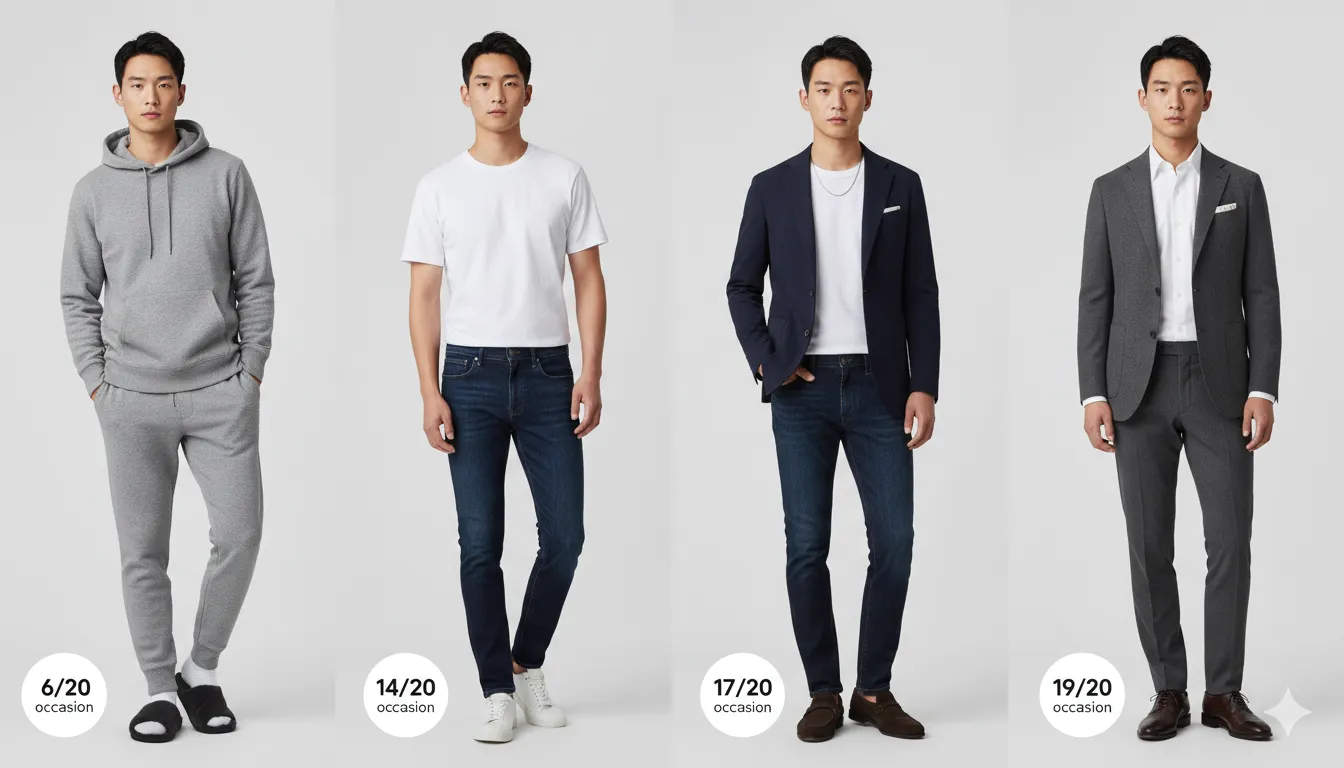
The same person, four different occasion-appropriateness scores. The score is not about the clothes being good or bad — it is about the clothes matching the context they signal.
The Two Scenarios Where It Collapses
Despite being the highest-averaging dimension, occasion appropriateness has the widest score range in the database. It can score 19/20 or 2/20 — more variability than any other dimension. The two scenarios that produce the lowest scores:
Scenario 1: Full loungewear outside. Matching comfort sets, fuzzy slides, or pyjama-adjacent clothing worn in any public context. This produces the near-zero scores and the explicit style warnings in the database. The AI's verdict: the outfit is not wrong per se — it is wrong for this context. As the analysis output states: "strictly limited to domestic environments."
Scenario 2: Over-formality in casual contexts. Less common in the database but occasionally flagged: formal attire in a clearly casual setting. A full suit for a casual street photo or beach setting creates the same contextual mismatch in the opposite direction. The AI reads the outfit as "appropriate for a different context than this one."
How to Push Occasion Appropriateness From 14 to 18+
The jump from "appropriate" (14/20) to "actively occasion-appropriate" (18–20/20) requires moving from passive to active context signals. Passive appropriateness is wearing the right clothes. Active appropriateness is wearing clothes that shows you considered the occasion specifically.
For work/office contexts
Add a structured bag or briefcase that signals professional readiness. Ensure the heel of the trouser has a clean break over the shoe. Tuck the shirt. These details score 18–19/20 because they signal awareness of professional expectations, not just compliance with them.
For social/evening contexts
Add one elevated accessory that would only make sense for an evening or event context — statement earrings, a structured clutch, a pocket square. These items signal deliberate occasion-dressing to the AI.
For casual everyday contexts
Ensure no element of the outfit creates a context conflict — no indoor footwear, no matching loungewear sets worn outside, no excessively formal pieces in otherwise casual looks. Eliminating conflict is the route to 18/20 in genuinely casual contexts.
For smart-casual contexts
Smart casual is the occasion context where the most improvement is available. Adding a blazer, swapping trainers for leather footwear, and choosing quality basics over casual ones actively signals smart-casual intent — which scores 17–19/20 compared to 13–15 for "smart casual but could be more casual."
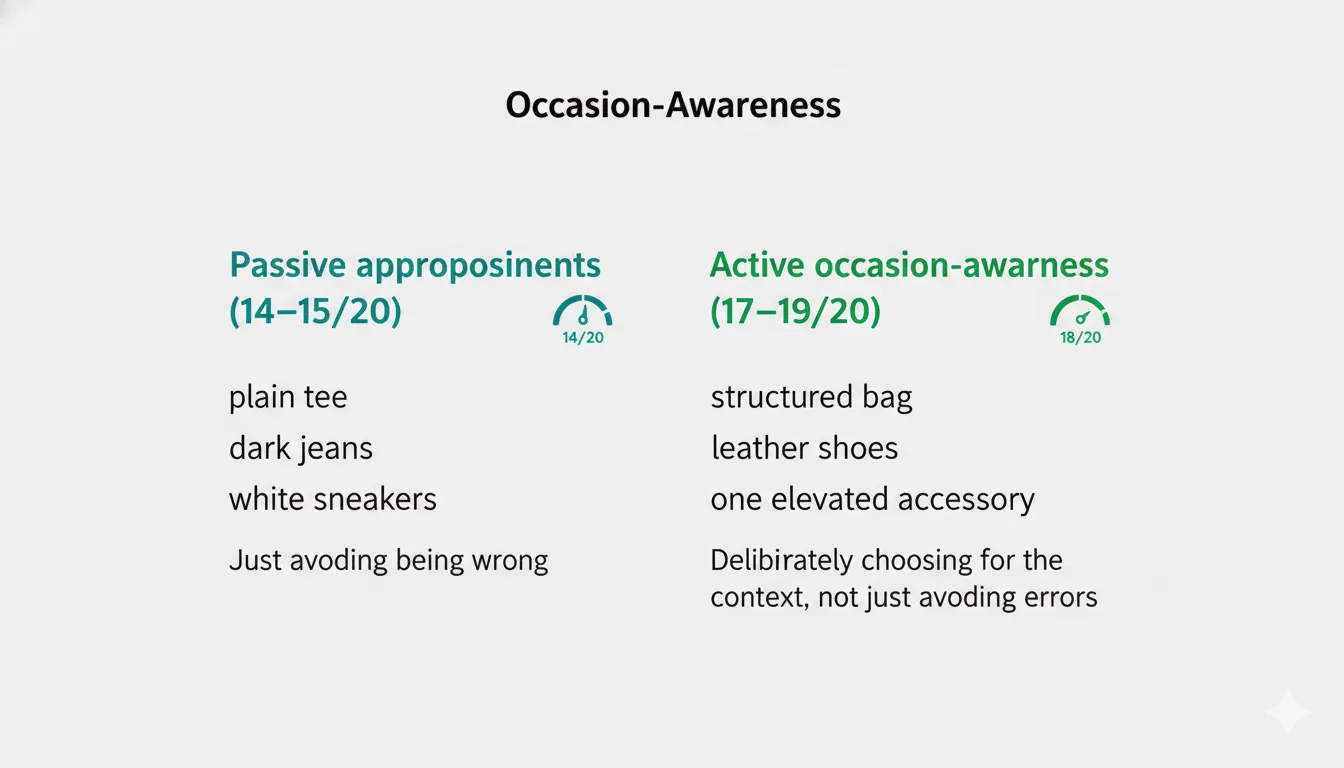
Passive: wearing the right clothes. Active: wearing clothes chosen specifically for this occasion. The difference is 3–4 points on the sub-score.
Find out your occasion-appropriateness score
Upload your outfit — specify the occasion — and see exactly what score the AI gives your contextual fit. See the full style analysis free.
Get My Outfit Score →Frequently Asked Questions
What is occasion appropriateness in AI outfit scoring?
It evaluates how well the outfit matches its social context. In OutfitScore's database it averages 14.4/20 — the highest of the five dimensions — because most people intuitively dress appropriately for their environment even without styling knowledge.
When does the occasion-appropriateness score drop to near zero?
In two scenarios: full loungewear worn in a public context (matching comfort sets with indoor footwear), and formal attire in a clearly casual setting. The first is far more common in our database and produces the explicit "do not wear outside" style warnings.
How do I score 18+ on occasion appropriateness?
Move from passive to active occasion signals. Passive is wearing appropriate clothes. Active is wearing clothes clearly chosen for this specific occasion — structured bag for office, statement earring for evening, leather shoes that match the formality of the occasion implied by the garments.
About the Author: Saad Sellami
Saad is the Founder and Lead Data Analyst at OutfitScore. With a background in software engineering, he analyzes tens of thousands of AI fashion assessments to uncover data-driven insights into how we dress, color theory, and styling patterns. Read more about the OutfitScore mission →