Texture Variety: The Invisible Weakness in Thousands of AI-Scored Outfits
"Lack of textural variety" is flagged across thousands of outfit analyses in the OutfitScore database — the second most common improvement area after missing accessories. Most people have never considered texture as something that's scored. It is. Here's exactly what the AI looks for and how to fix it, most of the time without buying a single new item.
Disclosure: Some links in this article are affiliate links. As an Amazon Associate, OutfitScore earns from qualifying purchases, at no extra cost to you.
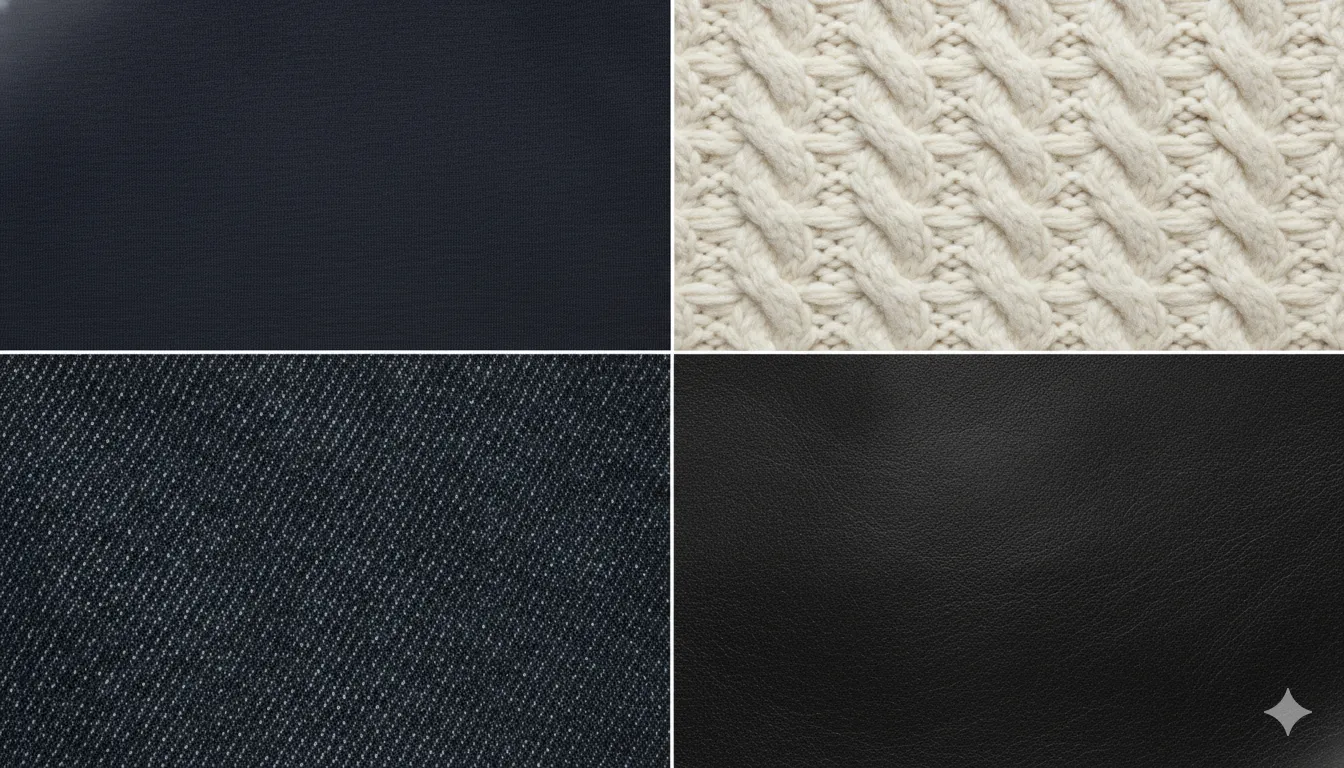
Most wardrobes contain all four of these textures. Most daily outfits use only one — usually the smooth cotton jersey in the top-left.
Advertisement
The details and quality sub-score in OutfitScore's AI style analysis averages just 10.6 out of 20 — the lowest of the five dimensions across thousands of analyses in the database. This is not primarily about garment quality or fabric price. It is about visual interest at the surface level. An outfit composed entirely of matte cotton — a jersey tee, plain cotton trousers, canvas shoes — has no surface variation. It reads as flat. The AI flags this as "monotonous texture" and reduces the details score accordingly.
The specific language that appears repeatedly in OutfitScore's analysis output: "lack of textural variety", "monotonous texture", "needs texture variation", "lack of textural depth", "lack of textural contrast." Different phrasings of the same problem — an outfit with no surface contrast between its components.
Advertisement
What Texture Actually Means in This Context
Texture in the AI scoring context means how a surface reflects light differently from the surfaces next to it. A smooth fabric reflects light uniformly. A ribbed knit catches light at angles. A leather surface reflects sharply. A suede surface absorbs it. When multiple different surface types appear in one outfit, the eye moves between them — creating visual depth and what the AI rewards as "intentional layering" and "styling depth."
This is distinct from pattern. A patterned fabric can still be monotonous in texture — a graphic print on a smooth jersey has no more surface variation than a plain jersey. Texture is about the physical surface structure of the fabric, not what is printed on it.
The single-texture trap
A plain t-shirt and plain cotton joggers are both matte jersey — same texture family, zero contrast. A plain t-shirt with dark denim jeans is already two textures: jersey and twill weave. A plain t-shirt with dark denim and a leather belt is three textures. Each addition raises the details and quality sub-score without changing the silhouette, colour, or visible styling at all.
The Five Most Effective Textural Pairings
1. Ribbed or cable knit + smooth denim
A chunky or ribbed knit sweater over slim dark jeans is the single most effective textural pairing in casual menswear and womenswear. The knit texture and the denim twill weave are clearly different surfaces. Score impact: +3–4 points on details sub-score versus the same outfit with a smooth jersey top instead.
2. Leather footwear + any fabric trouser
This is the easiest texture contrast to add because it's entirely in the footwear choice. Any leather shoe — white leather sneakers, Chelsea boots, loafers — creates a surface contrast against cotton, denim, or linen trousers. It's why clean leather shoes score 7 points higher than athletic trainers in similar outfits.
3. Denim jacket over jersey top
The denim woven twill against a jersey t-shirt or sweater creates a clear surface contrast. The denim jacket is also the most recommended outerwear item in the OutfitScore database for exactly this reason — it adds texture contrast and layering depth simultaneously.
4. Metal accessories against cotton or jersey
A silver chain necklace or metal watch against a plain jersey tee is a texture pairing, not just an accessory addition. Metal reflects light sharply against a matte surface — this is part of why the AI rewards a single chain so highly even on an otherwise simple outfit.
5. Suede or velvet accent against smooth fabric
Suede shoes or a velvet-trimmed detail against smooth cotton or linen creates a matte-textured-against-smooth-matte contrast — subtler than leather but still clearly different. Suede desert boots are the third most recommended footwear in the OutfitScore database in part because of this textural contribution.
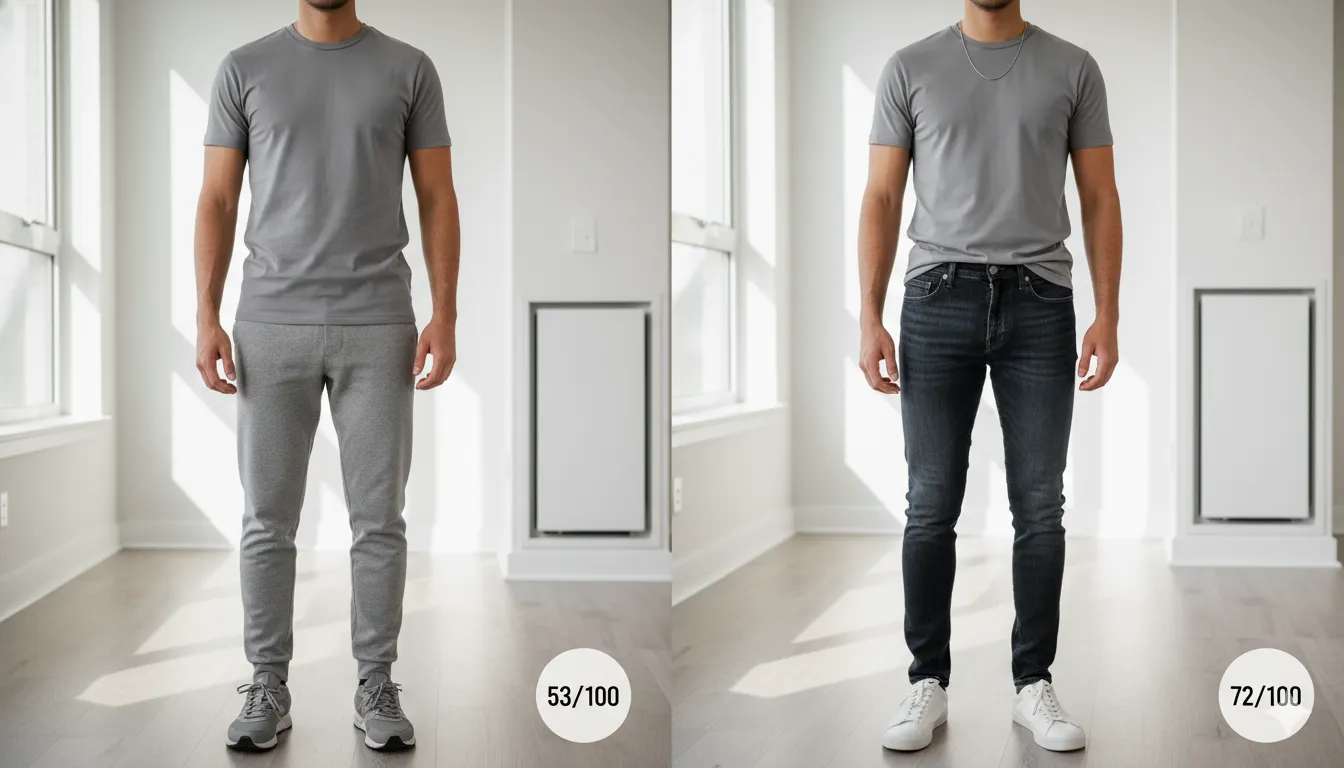
From 53 to 72 by adding three different surface textures to the outfit. The t-shirt is identical. The colour change is minimal. The texture change is everything.
Adding Texture Without Buying Anything New
The majority of the textural improvements in the OutfitScore data are achievable with existing wardrobe items. The most common missed opportunity is not wearing the leather shoes that are already owned because "they're too formal for this outfit." In most cases, a clean leather shoe is not too formal for a casual outfit — it is exactly the right surface contrast to lift the details score.
Similarly: a leather belt worn instead of no belt, a silver watch worn instead of bare wrist, a denim jacket over a plain tee instead of just the tee — all of these are texture additions that require zero spending if the items are already in the wardrobe.
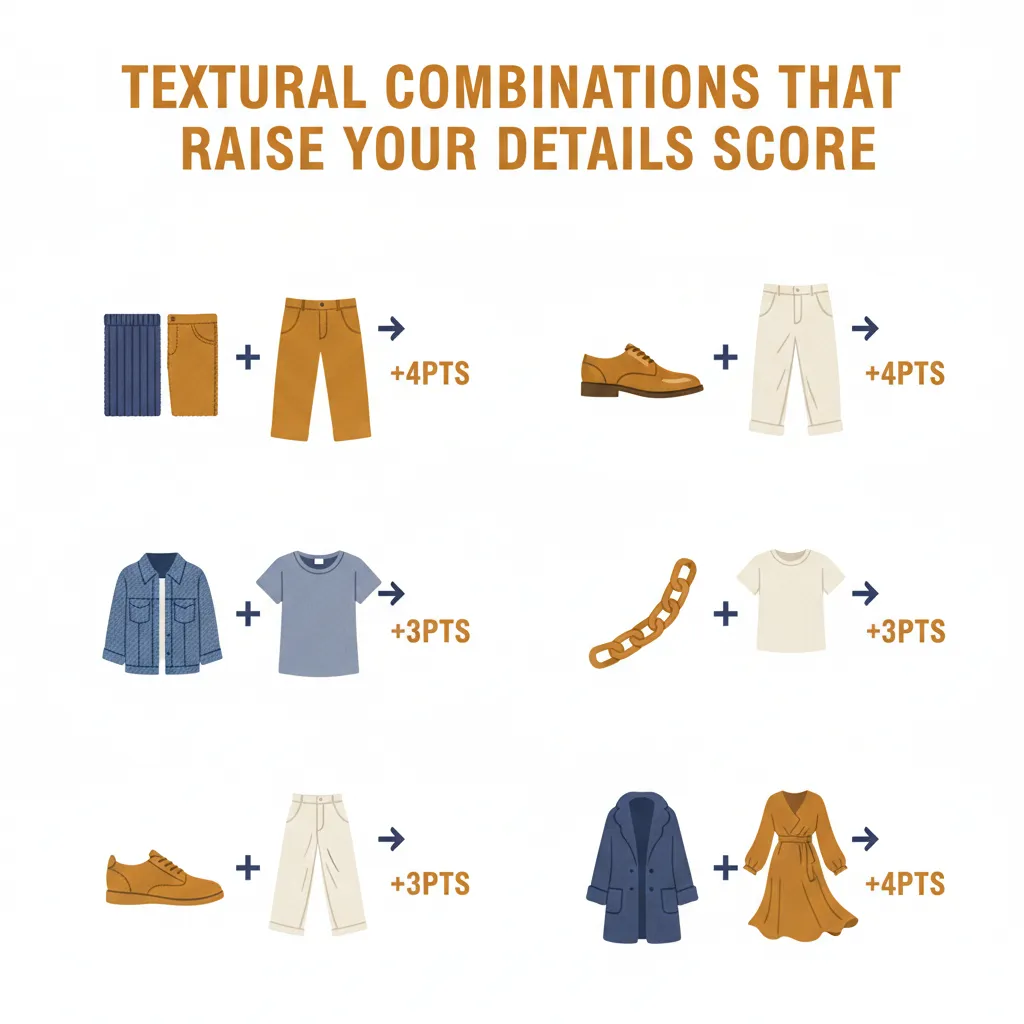
Six combinations that improve the details score in OutfitScore analyses. Most require nothing new — just choosing the right existing piece.
Find out what texture your outfit is missing
Upload your outfit and get AI style analysis with a specific breakdown of your details and quality score — including what textural elements would improve it. Free.
Rate My Outfit Free →Frequently Asked Questions
What is textural variety in fashion?
The deliberate combination of different fabric surface types within one outfit — leather against cotton, ribbed knit against smooth denim, metal accessories against jersey. AI outfit analysis evaluates this as part of the details and quality sub-score, the lowest-averaging dimension in OutfitScore's database at 10.6/20.
How much does texture affect an outfit score?
Adding one clear textural contrast to an outfit typically improves the details and quality sub-score by 3–5 points. Over the full outfit score this translates to roughly 3–5 points total improvement — significant given the average outfit scores just 60.4 in the database.
How do I add texture without buying new clothes?
Add a leather belt (leather against cotton), wear the leather shoes already in your wardrobe instead of athletic trainers, add a silver chain necklace (metal against jersey), or throw a denim jacket over a plain tee. All four create textural contrast with existing items.
Is pattern the same as texture?
No. Pattern is what's printed on a fabric. Texture is the physical surface of the fabric itself. A graphic print on smooth jersey is still monotonous in texture. A plain ribbed knit has strong texture with no pattern. They contribute to different scoring dimensions.
About the Author: Saad Sellami
Saad is the Founder and Lead Data Analyst at OutfitScore. With a background in software engineering, he analyzes tens of thousands of AI fashion assessments to uncover data-driven insights into how we dress, color theory, and styling patterns. Read more about the OutfitScore mission →