How to Score 85+ on OutfitScore: What the Top 0.3% of Users Do Differently
Across thousands of fashion analyses in the OutfitScore database, fewer than 0.5% of outfits score 85 or above. This is not because the bar is artificial — it is because scoring 85+ requires every one of the five scoring dimensions to perform at a high level simultaneously. Here is what our rarest high-scoring outfits have in common, drawn directly from our own analysis data.
Saad Sellami
Founder & Data Analyst
Published: April 22, 2026
Reading time: 8 minutes
Disclosure: Some links in this article are affiliate links. As an Amazon Associate, OutfitScore earns from qualifying purchases, at no extra cost to you.
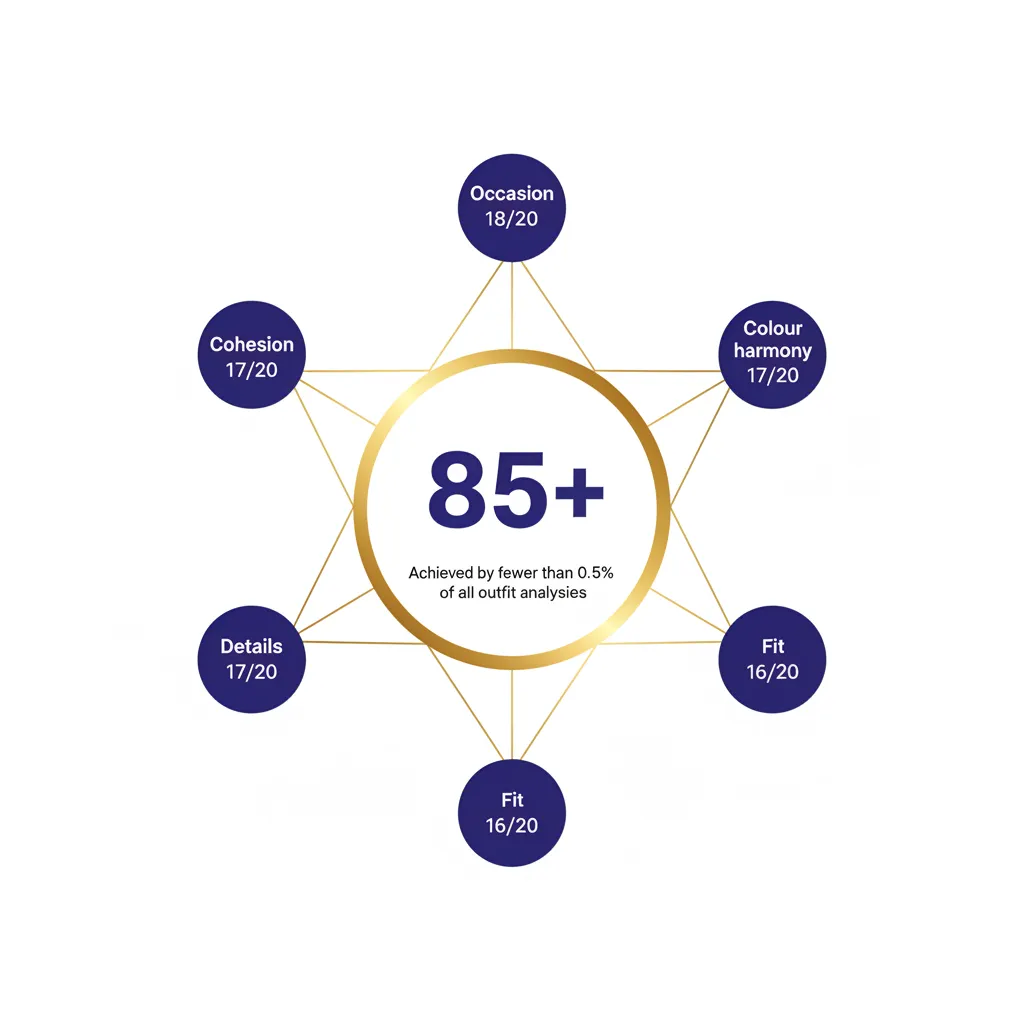
Scoring 85+ is not about one excellent dimension — it requires all five to perform well simultaneously. One weak sub-score caps the total below 85.
Advertisement
The average outfit score in the OutfitScore database is 60.4. The 75th percentile is just 67. Scoring 85+ is not a marginal improvement — it requires being in the top fraction of a fraction of all analysed looks. It also requires understanding that most quick fixes — the French tuck, a chain necklace, clean sneakers — push scores from the 55–65 range to the 68–74 range. They do not push scores to 85+. That requires something more systematic.
Based on OutfitScore's internal data — the only source that has this information — here is what separates the outfits that score in the 85+ range from everything else.
Advertisement
The Six Characteristics of 85+ Outfits
1. A deliberate, limited colour palette
High-scoring outfits almost universally use two to three colours with a clear hierarchy: one dominant colour (60–70% of the visual area), one secondary colour (20–30%), and one accent that ties the accessories to the garments. The palette is not complicated — it is controlled. Navy dominant, white secondary, tan leather accent. Cream dominant, camel secondary, black accent in shoes and belt. The restraint is what the AI rewards under colour harmony.
2. At least two coordinated accessories
Every 85+ outfit in the OutfitScore database has at least two accessories — and critically, they are coordinated rather than random. A gold necklace with gold earrings. A brown leather belt matching suede desert boots. A silver watch with silver-toned footwear eyelets. The cohesion sub-score (which averages 10.7/20) requires this kind of deliberate accessory coordination to score 17–18/20.
3. At least one clear textural contrast
Outfits that score 85+ always contain at least one textural pairing: a smooth leather shoe against a matte cotton trouser, a chunky knit sweater against silky slim trousers, a suede jacket over a plain cotton tee. The details and quality sub-score (the lowest at 10.6/20) requires textural variety to reach 17+. Without it, even well-styled outfits plateau in the high 70s.
4. Zero graphic prints as primary garments
Not one of the rare 85+ outfits in the database features a graphic print as the primary garment. This is the clearest binary distinction in the data. Graphics can appear as accents — a small logo on a quality piece, a subtle pattern — but the large-format graphic print that dominates the look caps the details and quality sub-score regardless of how well everything else is styled.
5. Precise fit — no pooling, bunching, or shapeless volume
Fit and proportion averages 11.7/20 across all analyses. In 85+ outfits, it scores 16–18/20. This requires actual well-fitting clothes — not oversized items given structure by a belt, not jeans hemmed to within an inch of the floor. The clothes either fit the body precisely, or they are deliberately oversized in one dimension only and intentionally balanced by something fitted in the other. Shapeless-on-both is incompatible with 85+.
6. A coherent aesthetic that has a name
This is the most subjective characteristic but also the most consistent. The highest-scoring outfits in the database have a clearly identifiable aesthetic — minimal, smart-casual, classic, contemporary streetwear — that is coherent from head to toe. Every element belongs to the same visual conversation. The AI rewards this under styling cohesion as "intentional," which is the highest praise the analysis generates.
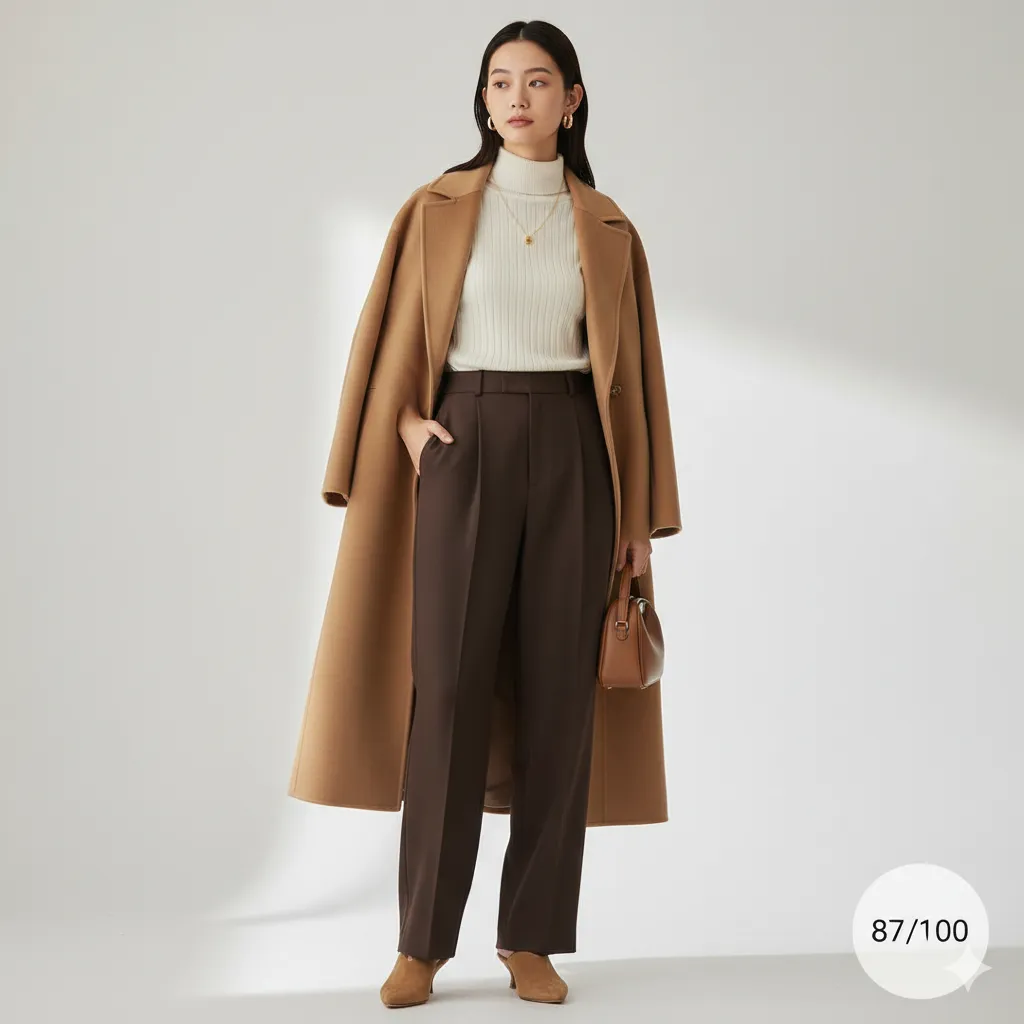
All six characteristics present: deliberate two-tone palette, two coordinated gold accessories, textural contrast (wool, ribbed knit, suede), no graphic print, precise proportions, coherent classic aesthetic.
The Path from 75 to 85 — What Changes
Most users who ask about scoring 85+ are already scoring 70–78. The gap from there is not about adding more — it is about eliminating the remaining weak points. The data shows a consistent pattern: the sub-score that is keeping a 75-scoring outfit below 85 is almost always either details and quality (the garments themselves need upgrading — better fabric, more interesting texture, no dated prints) or styling cohesion (the accessories are present but not coordinated with each other).
The 75 → 85 upgrade checklist
Replace the lowest-quality garment in the outfit with a higher-quality version in the same colour — texture upgrade without style change.
Ensure your two accessories share a metal tone (both silver or both gold) or a material type (both leather in similar shades).
Add one textural contrast that isn't currently present — knit over smooth, leather against fabric, suede with cotton.
Remove any graphic print from the primary garment — replace with a plain or subtly patterned version.
Ensure footwear shares at least one colour relationship with the rest of the outfit — not just "neutral and inoffensive."
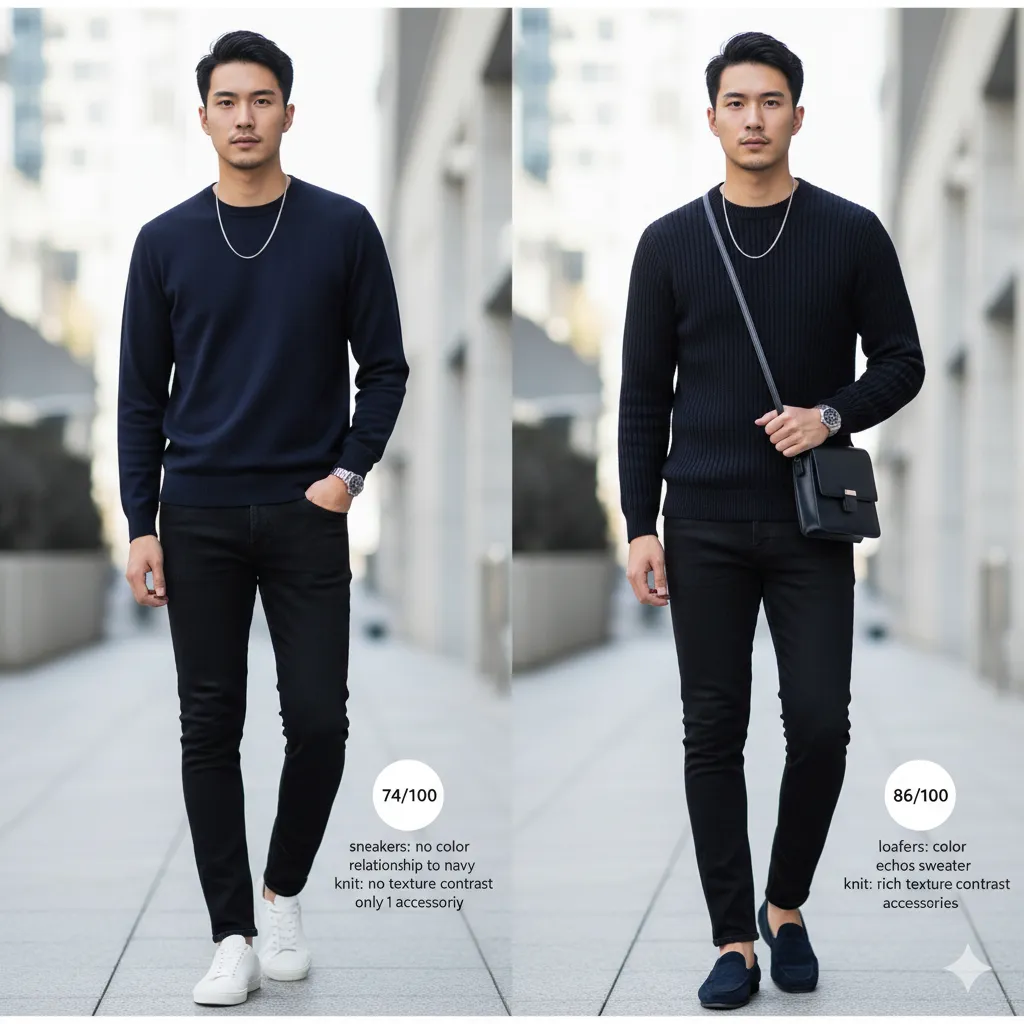
From 74 to 86: the garment quality upgraded (ribbed texture), footwear now echoes the outfit colour, and two accessories are coordinated in metal rather than being single and unrelated.
Why Scoring 85+ Is Rare — and Should Be
The rarity of 85+ scores is not a flaw in the system — it is a feature. If 20% of outfits scored 85+, the score would convey no meaningful information. The OutfitScore database sets 85+ as genuinely exceptional because it requires everything to work at once. Most well-dressed people score 72–78. That is genuinely good. The 85+ threshold exists to distinguish "good" from "exceptional."
The practical takeaway: aim for 72–78 as your consistent baseline. That range means you've eliminated the major issues and are making deliberate styling choices. Pursuing 85+ requires garment investment, not just styling investment — and that is a deliberate personal decision, not a necessity.
Find out your current score — and what's capping it
Upload your best outfit and see exactly which sub-score is preventing you from reaching 85. The feedback is specific. Free.
Rate My Outfit Free →Frequently Asked Questions
What outfit score is considered excellent?
70–74 is above average (top 25% in our database). 75–84 is excellent. 85+ is exceptional, achieved by fewer than 0.5% of all analysed outfits. The average across thousands of OutfitScore analyses is 60.4.
What do 85+ scoring outfits have in common?
Based on OutfitScore's database: deliberate 2–3 colour palette, at least two coordinated accessories, one clear textural contrast, no graphic prints as primary pieces, precisely fitted garments, and a coherent identifiable aesthetic throughout.
What is the highest outfit score recorded in the OutfitScore database?
The highest scores in the database are in the 88–92 range. A perfect 100 has never been recorded. 85+ scores are achievable but require strong performance across all five dimensions simultaneously.
Can I score 85+ with fast-fashion clothes?
It is very difficult. The details and quality sub-score — which averages just 10.6/20 — evaluates fabric texture and garment construction. Fast-fashion pieces with thin fabric, poor construction, or heavy graphic printing cap this sub-score below what's needed for an 85+ total.
About the Author: Saad Sellami
Saad is the Founder and Lead Data Analyst at OutfitScore. With a background in software engineering, he analyzes tens of thousands of AI fashion assessments to uncover data-driven insights into how we dress, color theory, and styling patterns. Read more about the OutfitScore mission →