10 Style Mistakes AI Always Catches — With Real Warning Text From Our Database
What follows is not paraphrased. Every quoted verdict in this article is extracted directly from OutfitScore's analysis database — real AI outfit rating feedback issued across thousands of analyses. These are the 10 mistakes the AI flags most frequently, with the exact language it uses, and what to do instead.
Disclosure: Some links in this article are affiliate links. As an Amazon Associate, OutfitScore earns from qualifying purchases, at no extra cost to you.
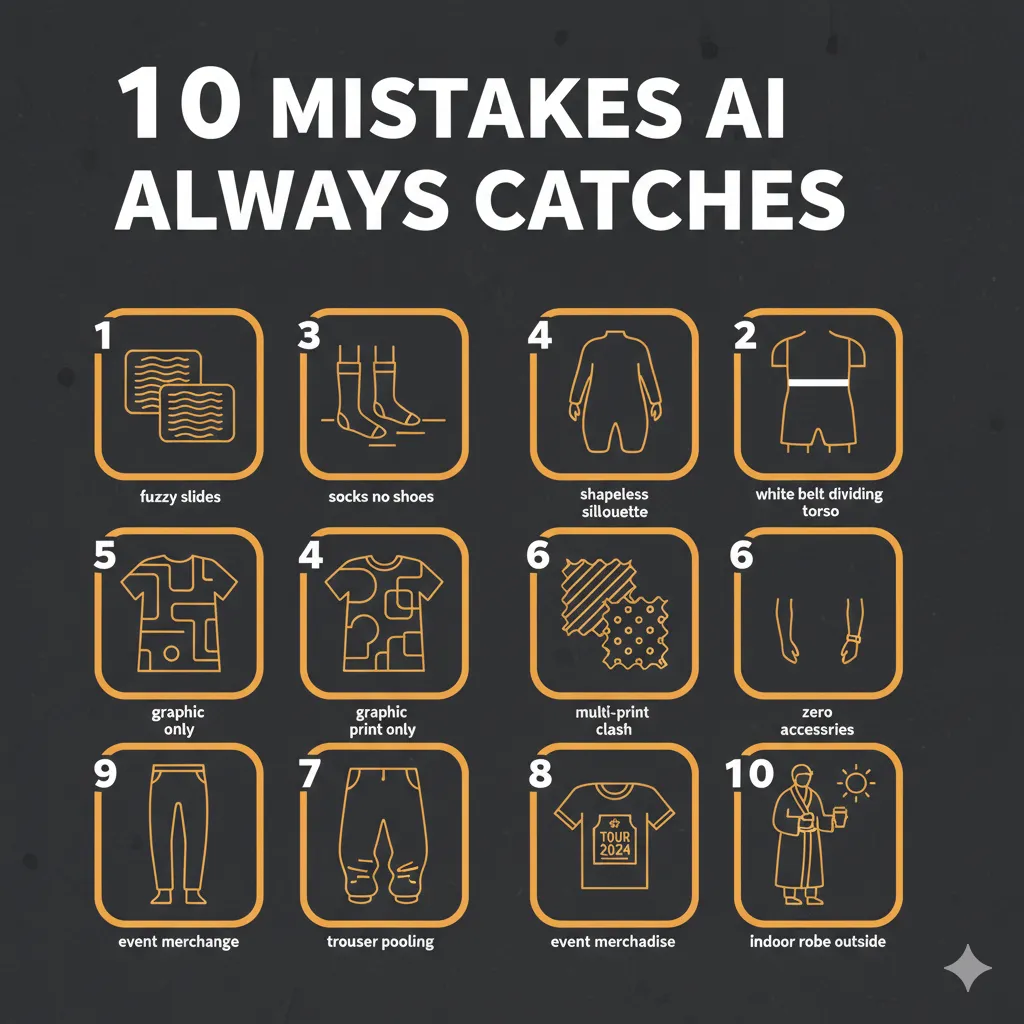
Ten mistakes. Thousands of instances. The AI flags every one — and the feedback is specific every time.
Advertisement
The OutfitScore AI fashion analyzer processes every uploaded photo through five scoring dimensions and generates specific, real-time style warnings when it detects issues. These warnings are not templated — they are generated contextually. But certain patterns are so universal that the same warnings appear again and again, word-for-word across thousands of completely different outfits.
What follows is based entirely on OutfitScore's own analysis data — warnings our users have received, pulled from our database, unmodified. No external source can provide this list because no external source has this data.
Advertisement
"Fuzzy slides are strictly for indoor use; wearing them outdoors will immediately degrade the perception of you and the entire outfit."
Fix: Clean white leather sneakers or leather slides (not fuzzy). This single swap is worth up to 7 points on the outfit score and removes the most definitive "not dressed for public" signal the AI reads.
"The white belt acts as a harsh divider that shortens the torso and breaks the outfit's continuity."
Fix: Match belt colour to shoes (both black or both brown) or match it to the dominant colour of your top. A belt should blend, not contrast. White or bright belts only work when the entire outfit is structured around that colour.
"Wearing socks without footwear in a public setting is a major styling error."
Fix: Always photograph your outfit with the footwear you intend to wear. Socks-only photos produce an immediate occasion-appropriateness penalty and the AI's feedback cannot account for footwear it cannot see.
"The current silhouette is extremely boxy; consider a half-tuck or a more fitted bottom to balance the volume. The oversized silhouette lacks intentional structure, resulting in a sloppy, shapeless appearance."
Fix: French tuck the front of the top, or add a leather belt at the waist. Either creates a visual anchor point that the AI reads as intentional proportion management.
"The graphic sweatshirt significantly lowers the maturity of the aesthetic. The graphic print anchors the entire outfit in a 'homewear' category."
Fix: Use the graphic piece as an accent surrounded by plain items, or swap it for a solid-colour version. Tuck the graphic tee partially to reduce its visual dominance. Add outerwear to frame it.
"The outfit lacks accessories or layering depth, appearing as a collection of random basics rather than a curated look. Zero visual interest has been created."
Fix: Add one focal piece — a silver chain necklace, minimalist watch, or leather belt. This single addition signals that the outfit was composed with intent, which is what the styling and cohesion sub-score rewards.
"Hem the trousers to achieve a cleaner break at the shoe. Get the trousers hemmed for a cleaner break."
Fix: Get trousers hemmed to achieve a slight break — the fabric should just touch the top of the shoe, not pool. This is a permanent fix that affects every outfit those trousers appear in. Average improvement: 6–8 points on fit sub-score.
"The multi-print combination creates significant visual fatigue."
Fix: Maximum one print per outfit for casual and everyday contexts. If wearing a patterned top, the bottom and accessories should be solid. If wearing patterned trousers, the top should be a plain neutral. Two prints can work — only if one is micro-scale and the other macro-scale, in matching colours.
"Avoid using event-branded merchandise as a primary accessory."
Fix: Event lanyards, festival wristbands, and branded tote bags are functional items rather than style choices. Remove them for photos, or recognise they actively lower the styling sub-score when worn as decorative elements.
"Ensure the polo hem does not extend past the mid-fly of the trousers to maintain proper proportions."
Fix: A polo worn untucked should end at or above the mid-point of the zip. If it extends further, tuck it — either fully or with a French tuck. A too-long polo untucked reads as an underwhelming fit, regardless of the quality of the garment.
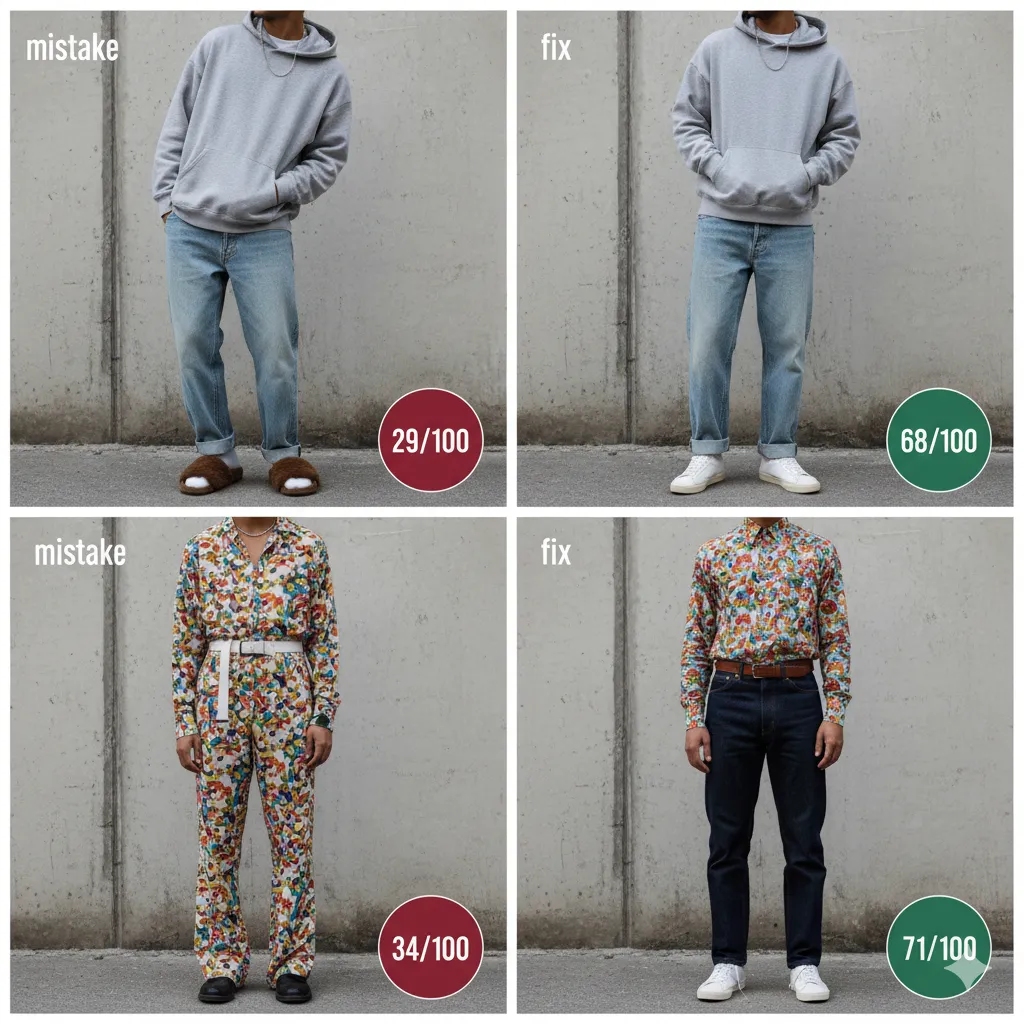
Mistakes 1, 4, 6, and 8 fixed side by side. The score jumps in each case come from addressing the specific AI warning — not from buying anything new.
The Pattern Behind the Warnings
Every warning in this list shares a common thread: it is a signal of unawareness rather than a signal of bad taste. The AI does not penalise bold choices or unusual aesthetics. It penalises choices that appear to have been made without consideration of how they read to an observer. Fuzzy slides outside signal you didn't consider footwear. A white belt signals you didn't consider how it divides the torso. Trouser pooling signals you didn't consider proportion.
This is why the fixes are so consistent — they're not about changing your style, they're about demonstrating that you made a decision. The French tuck says "I considered my waistline." The silver chain says "I considered what sits against my collar." Clean sneakers say "I considered what I put on my feet." These signals are what push an outfit rating from 58 to 72.
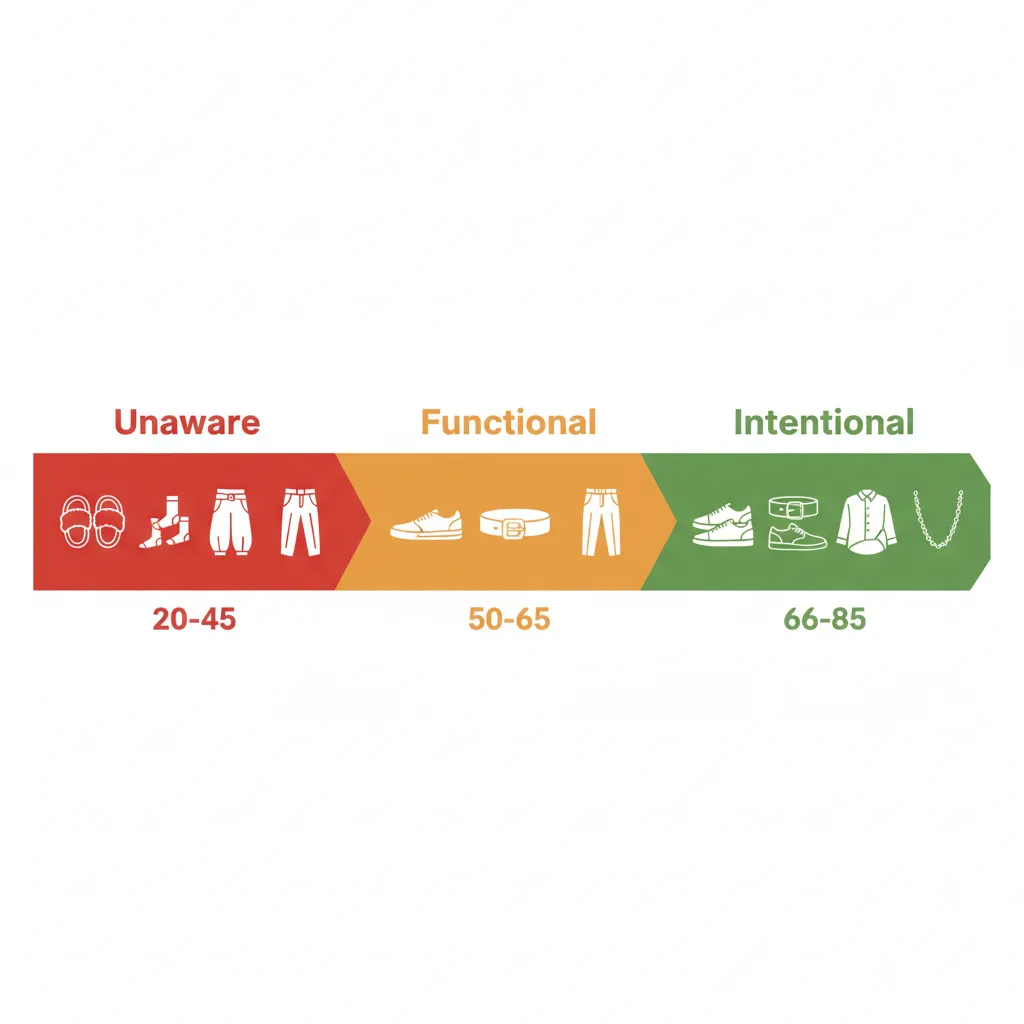
The AI isn't scoring taste — it's scoring awareness. Every warning in this article is a signal of unawareness, not bad style.
Find out which warnings your outfit triggers
Upload your outfit and see the exact style warnings the AI generates — specific to your photo, not generic. Free outfit check, no signup needed.
Rate My Outfit → Get It Roasted 🔥Frequently Asked Questions
What style mistakes does AI outfit analysis always catch?
Based on OutfitScore's database: indoor footwear outside, white belt as torso divider, socks without shoes, shapeless silhouettes, graphic prints as sole focal point, zero accessories, trouser pooling, multi-print clashing, event merchandise as accessories, and polo hems that are too long. These appear across thousands of analyses with remarkably consistent language.
Is the AI feedback in this article real or generated?
Real — pulled verbatim from OutfitScore's analysis database. These are actual style warnings issued to actual users across thousands of outfit analyses. They have not been paraphrased or softened.
How harsh is the standard AI outfit feedback?
Standard analysis is constructive — specific, direct, but not deliberately harsh. The warnings above represent the direct end of the spectrum. Roast mode, which is opt-in, produces significantly more direct feedback. The style warnings in this article are from standard analysis mode.
About the Author: Saad Sellami
Saad is the Founder and Lead Data Analyst at OutfitScore. With a background in software engineering, he analyzes tens of thousands of AI fashion assessments to uncover data-driven insights into how we dress, color theory, and styling patterns. Read more about the OutfitScore mission →