Which Photo Type Gets a Better AI Outfit Score?
We compared real AI outfit scores across every photo type people actually upload — mirror selfies, full-body shots, flat lays and more — to answer the question users ask most: what should I photograph to get the most accurate AI outfit score?
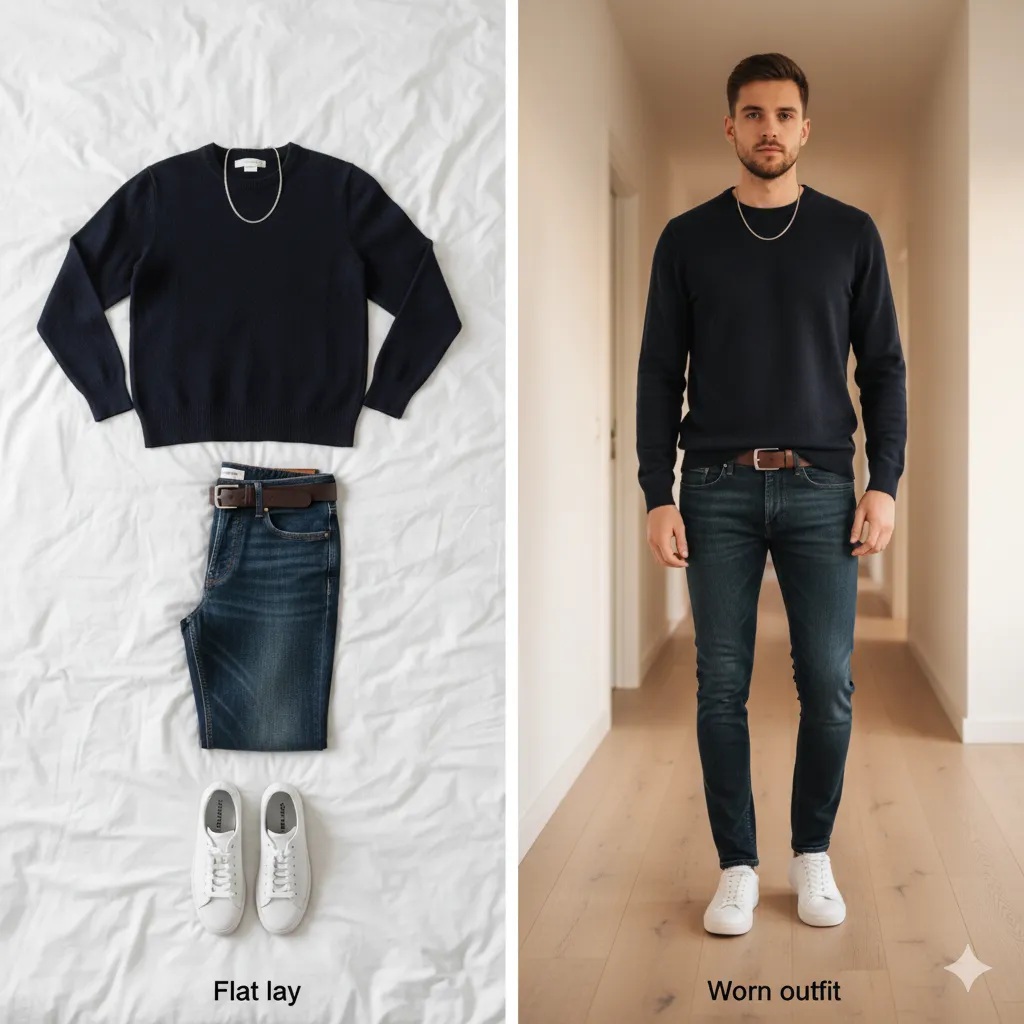
The format you upload changes what the AI can see — and measurably changes the score you get back.
Worn full-body photos get the highest average AI outfit score of any common photo type — 67/100 — against 63/100 for mirror selfies, which are the most common upload at 46.5% of the 6,332 photos in this analysis. The gap is even larger at the top end: 17.5% of worn full-body photos score 80 or above, versus 2.7% of mirror selfies.
This is not the AI being strict with a selfie — it is the information available in the photo. A mirror selfie hides your footwear, crops your silhouette and distorts proportions, so the dimensions the AI outfit rater can actually assess are fewer. A full-body worn photo gives it all five: fit, colour, occasion, styling and detail.
Advertisement
Every Photo Type, Scored
9,238 outfit analyses sit in the six-month window. A photo type was only recorded from 2026-05-18 onward, so the figures below cover the 6,332 photos that carry one. Score columns are only shown for photo types with at least 100 samples — below that a mean is one person, not a finding.
| Photo type | Volume | Share | Mean score | Median | Score 80+ | Score <50 | Rejected |
|---|---|---|---|---|---|---|---|
| Mirror selfie | 2,942 | 46.5% | 63 | 63 | 2.7% | 6.6% | 4.5% |
| Worn full body | 1,991 | 31.4% | 67 | 66 | 17.5% | 7.7% | 8.0% |
| Flat lay | 492 | 7.8% | 64 | 64 | 8.2% | 6.6% | 3.7% |
| Worn upper body | 350 | 5.5% | 63 | 64 | 11.9% | 12.8% | 16.6% |
| Seated | 179 | 2.8% | 66 | 66 | 18.5% | 12.4% | 5.0% |
| Hanger shot | 81 | 1.3% | below sample floor — not published | ||||
| Unclear | 72 | 1.1% | below sample floor — not published | ||||
| Side profile | 56 | 0.9% | below sample floor — not published | ||||
| Back view | 36 | 0.6% | below sample floor — not published | ||||
| Group photo | 32 | 0.5% | below sample floor — not published | ||||
| Single garment | 28 | 0.4% | below sample floor — not published | ||||
| Face only | 26 | 0.4% | below sample floor — not published | ||||
| Worn lower body | 18 | 0.3% | below sample floor — not published | ||||
| Closet overview | 18 | 0.3% | below sample floor — not published | ||||
| Action shot | 7 | 0.1% | below sample floor — not published | ||||
| Worn face and torso | 3 | 0.0% | below sample floor — not published | ||||
| Not an outfit | 1 | 0.0% | below sample floor — not published | ||||
Rejected = the photo-quality gate refused the image before scoring (blurry, too dark, heavily cropped, filtered, or no outfit visible). Rejected analyses carry no score, so they are counted in volume but excluded from the score columns.
Why Mirror Selfies Score Lowest — Even Though They Are Most Common
Mirror selfies are 46.5% of every photo type we record — by far the most common way people photograph their outfit. They average 63/100, the lowest of the five formats with enough data, and only 2.7% reach 80 or above. That last number is the tell: it is roughly 6x lower than a worn full-body photo. To score well, the AI needs to see the whole outfit and how it fits — a mirror selfie usually hides footwear, truncates the leg, and bends the proportions of the silhouette.
The mirror selfie blind spot
If your outfit's weak point is below the waist — hem length, trouser pooling, the wrong shoes — a mirror selfie will happily score the top half and miss the actual problem. That is not a flattering review; it is an incomplete one.
Flat Lays: Decent Scores, Missing the Point
Flat lays average 64/100 with a rejection rate of just 3.7% — the clean, well-lit flat lay rarely gets refused. The catch is structural. Our AI outfit rater scores five dimensions, and a flat lay only gives it four of them:
| Dimension | Flat lay | Worn outfit |
|---|---|---|
| Colour harmony | Fully assessed | Fully assessed |
| Details and quality | Fully assessed | Fully assessed |
| Styling and cohesion | Largely assessed | Fully assessed |
| Fit and proportion | Garment cut only — body fit invisible | Fully assessed on body |
| Occasion appropriateness | Inferred from garments only | Full context including setting |
Fit and proportion is the dimension that decides whether a look reads as intentional. A flat lay cannot see that jeans pool at the ankle or that a sweater swamps the frame, so it scores the garments generously and misses the real issue. Flat lays score the clothes. Worn outfits score the look.
What flat lays are actually good for
A flat lay is the right tool when the question is about the clothes, not the body: testing whether a palette works before dressing, checking whether a new purchase integrates with your wardrobe, coordinating accessories, and batch-planning outfits for a trip. For a personal fit check, wear the clothes.
Worn Upper-Body: The Highest Rejection Rate
Worn upper-body crops are the surprising outlier: 16.6% of them are refused outright — the highest of any common format, against 4.5% for mirror selfies. The reason is the photo-quality gate: crop in too tight and the image no longer shows enough of the outfit to be scored at all, or it loses a pair of shoes that the analysis needs. When they do get through, upper-body photos average 63/100 — a full-body shot is strictly more informative for roughly the same effort.
Why Each Format Behaves the Way It Does
Mirror selfies
Hide footwear, truncate the leg, and lean the perspective. The AI scores what it can see, so the score reflects a partial outfit.
Worn full body
The only common format that shows the whole outfit on the body in a neutral line — every dimension is assessable.
Flat lay
Perfectly visible garment-level detail, but no body fit. Scores the clothes, not the look — generous when fit is the problem.
Seated
Rare but scores well — seated photos usually capture a dressed-up occasion where the whole torso and footwear remain visible.
Advertisement
How to Photograph an Outfit for the Most Accurate Score
- 1
Wear the outfit. A full-body worn photo is the only format that lets the AI assess fit, which is the dimension that most separates good scores from average ones.
- 2
Show everything, feet to head. Step back far enough that no part of the outfit is cropped — footwear is a scored detail and the most common thing a crop removes.
- 3
Use even, bright light. Darkness and blur are the two most common rejection reasons across every format.
- 4
No heavy filters. Filters that shift colour are scored as heavily filtered and are a top-three rejection reason.
- 5
Keep the angle level. Extreme angles distort proportion — the same reason mirror selfies under-score. A straight-on or slightly elevated shot is best.
Try it — see what your photo type changes
Upload a photo and get a free outfit check with the full five-dimension breakdown. No signup needed.
Rate My Outfit Free →Method and Limits
We analysed 9,238 outfit analyses submitted to OutfitScore between 2026-04-07 and October 07, 2026, of which 6,332 recorded a photo type (recording of this field began on 2026-05-18). Figures cover those 6,332 photos. Soft-deleted free analyses are included — deletion only removes the stored image, not the data. A score column is published only when a photo type had at least 100 samples.
Correlation is not causation. People who upload a mirror selfie may simply dress differently from people who take a full-body photo. The gap is real and measurable, but it describes photos, not people — and it says nothing about how the AI "feels" about a selfie.
Want to see how your own score is built? Read Anatomy of a Score or check whether your outfit is right for the occasion with the right-for-you guide.
Frequently Asked Questions
How should I photograph my outfit?
Wear it and shoot a full-body photo in even lighting, with no filter and a level angle. Worn full-body photos are the most accurate format for an AI outfit score — they show fit, which is the dimension a score depends on most.
Do flat lays score lower?
Not necessarily — flat lays average close to the overall average in our data. But they cannot assess fit, so they over-reward garments that hide fit problems. For a personal fit check, wear the outfit.
Is a mirror selfie good enough?
It produces a score, but it is the weakest common format: mirror selfies score lowest on average and very rarely reach 80 or above. A worn full-body photo is strictly better for an accurate score.
Why did my photo get rejected?
The most common rejection reasons are blur, darkness, heavy cropping, heavy filters, extreme angles, and photos with no visible outfit. Re-framing with your whole outfit in frame and better light fixes most of them.
Score Your Outfit Now
You can also check whether a top and bottom work together with the does this outfit match tool, or build a scored outfit from your own wardrobe in the virtual closet.