The Psychology of Fashion: How Your Clothes Affect Your Confidence and Mood
It's not just in your head—what you wear has a direct and measurable impact on your psychological state. Discover the science of "enclothed cognition" and learn to dress for success.
Disclosure: Some links in this article are affiliate links. As an Amazon Associate, OutfitScore earns from qualifying purchases, at no extra cost to you.
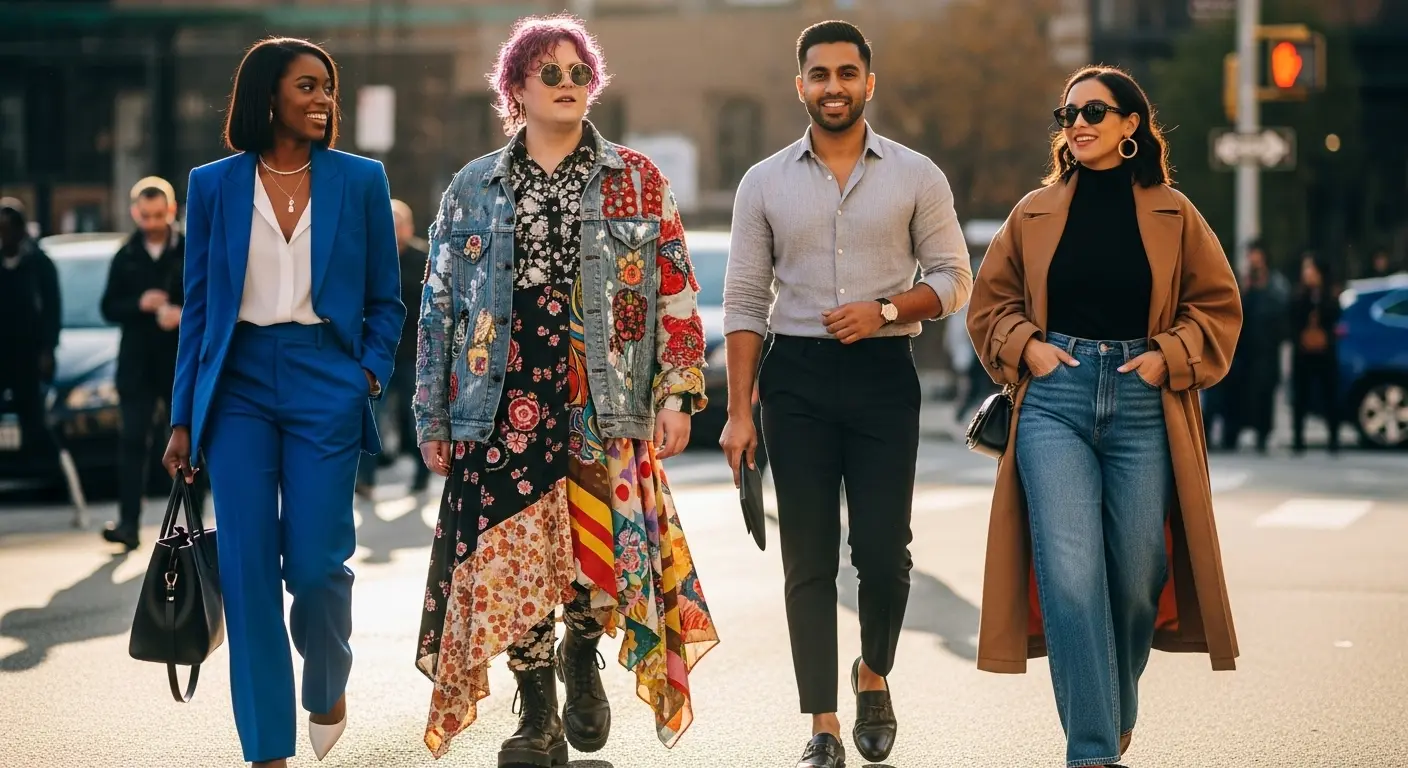
Your outfit is a powerful tool for shaping your mindset.
Advertisement
We've all experienced it: the confidence boost from a perfectly tailored blazer, the joy of a brightly colored dress on a sunny day, or the comfort of a favorite cozy sweater. This isn't just a feeling; it's a scientific phenomenon known as enclothed cognition (a term first coined in a landmark 2012 study published in the Journal of Experimental Social Psychology).
🧠 What is Enclothed Cognition?
Enclothed cognition is the systematic influence that clothes have on the wearer's psychological processes. In simple terms, it's the idea that our clothing choices can change the way we think, feel, and act.
How to Dress for the Mindset You Want
To Feel Confident: The Power Suit Effect
When you wear clothing you associate with power and authority (like a blazer or structured dress), you are more likely to think and act in a more powerful and confident manner. This is perfect for job interviews, important meetings, or any time you need a self-esteem boost.
To Feel Creative: Break the Rules
Wearing something slightly unconventional or mixing patterns can signal to your brain that it's okay to think outside the box. This can lead to more creative problem-solving and innovative ideas.
To Feel Focused: The Uniform Advantage
Wearing a consistent "work uniform" (even if it's just a specific type of outfit) can reduce decision fatigue in the morning, freeing up mental energy for more important tasks. This is why many successful entrepreneurs adopt a signature look.
To Feel Happy: The Dopamine Dress
Bright colors and fun patterns can genuinely lift your mood. This is known as "dopamine dressing." Wearing yellow can evoke feelings of happiness and optimism, while blue can have a calming effect.
Advertisement
Six confidence outfits the AI has already scored
Each score below is a mood scenario and the outfit that produced the result. The point is not the number alone — it is which combination reliably moved the wearer into the state they wanted.
Interview Power Look
84/100Structured navy blazer, crisp white shirt, tailored grey trousers, and leather oxfords. The formality matched the occasion and the sharp contrast read as authority, which is exactly the state the wearer needed before walking in.
Boardroom Presentation
81/100Charcoal two-piece suit, light blue shirt, and a silk tie. The monochrome base plus one controlled accent kept the focus on the speaker rather than the clothes — the visual equivalent of a steady, focused voice.
Dopamine Dress Day
78/100Mustard yellow coat over a cream knit with navy trousers. The bright outer layer carried the mood lift without clashing, because the neutral base let the colour do the emotional work instead of competing with it.
Creative Brainstorm
74/100Mixed-pattern shirt, relaxed pleated trousers, and colourful socks. The intentional rule-breaking signalled to the wearer that unconventional thinking was allowed, and the palette stayed tonal enough to remain cohesive.
Signature Uniform Monday
72/100Grey merino knit, dark straight-leg denim, white sneakers. The look trades peak impact for zero decision fatigue, and the predictable palette is what frees mental energy for the work that actually matters.
Notice the range: 67 to 84. Confidence dressing is not about chasing the highest number — it is about matching the outfit's projected signal to the mental state you are trying to create that day.
Get Your Confidence Score
Our AI doesn't just score your style; it analyzes the psychological impact of your outfit. Find out how your look projects confidence and get tips to enhance it.
Analyze My Outfit's VibeInside the Research: How Enclothed Cognition Actually Works
The lab coat experiment
In the original 2012 experiments by Hajo Adam and Adam Galinsky, participants put on a white lab coat while completing a task that demanded sustained attention. One group was told it was a doctor's coat; another was told it was a painter's coat. The group wearing the "doctor's" coat made significantly fewer errors. The garment was physically identical in both conditions — only the meaning attached to it changed. That is the core mechanic: the effect travels through the label your mind gives the clothing, not through the fabric.
Two conditions must both be true
Enclothed cognition appears only when two things happen at once. First, you have to actually wear the garment rather than picture it or see it on a hanger. Second, you have to hold a positive symbolic association with what that garment represents. A blazer sitting in your wardrobe has no effect; a blazer you privately think of as frumpy can even work against you. This is why the same item can sharpen one person and leave another completely unchanged — the association is doing the work, and it is personal.
What the research does not claim
The measured effects in this literature are modest and highly context-dependent, and later replication attempts have produced weaker results than the original studies. Enclothed cognition is not a switch that converts anxiety into charisma. It is a small upward nudge on attention, self-perception, and posture. Treat it as one input alongside sleep, preparation, and actual competence — useful, but not a substitute for any of them.
The Confidence-Feedback Loop — and How to Use It
Why confidence and clothing reinforce each other
Confidence and clothing form a loop rather than a one-way street. Wearing an outfit you believe projects competence nudges your posture and your self-talk upward. Better posture and steadier self-talk change how other people respond to you, and their responses confirm the belief that the outfit works. Each pass through the loop strengthens the association. The practical consequence: build on outfits that have already earned a real, positive response, because you are reinforcing a loop rather than making a one-off statement.
Colour psychology, with the caveats attached
Colour associations are learned, not universal. Red is linked to dominance in many Western contexts, blue to competence and calm, and yellow to optimism — but the same hue can signal mourning in one culture and celebration in another, and personal memory overrides general rules. A colour you associate with a difficult period will not lift you no matter what a colour wheel says. Use cultural and colour-theory guidance as a starting hypothesis, then verify it against your own associations before trusting it with a high-stakes day.
Dressing through anxiety
Anxiety narrows your tolerance for uncertainty, which is why ambitious or untested outfits tend to increase it rather than relieve it. When you know you will be anxious — an interview, a difficult conversation, a first day — reduce the variables. Wear a silhouette you have worn before, in a fabric that needs no adjusting, and keep the palette to two tones. Novelty is a useful confidence tool on low-stakes days, but familiarity is the better tool when the stakes are high. Save the untested new suit for the second meeting, not the first.
Building a repeatable confidence uniform
A confidence uniform is three to five combinations that reliably produce the feeling of being capable, documented so you do not have to rebuild the decision under pressure. To build one, recall the last three times you felt genuinely on form, note what you wore, and list the shared elements — a structured shoulder, a particular collar, a colour that photographs well on you. Keep those combinations intact as defaults. The AI score then becomes a confirmation rather than a search: you upload a stored favourite to check it still projects the way you remember, or test whether a single swap improves it.
Frequently Asked Questions
What is enclothed cognition?
It is the influence clothing has on the wearer's psychological processes. The term comes from a 2012 study in the Journal of Experimental Social Psychology showing that the symbolic meaning of a garment plus actually wearing it changes how people think, feel, and perform.
Can changing my clothes really change my mood?
Yes. Clothing carries symbolic meaning, so putting on a garment you associate with calm, power, or celebration primes the matching mental state. A tailored blazer can sharpen focus before a meeting; a bright dress can lift a low day.
What should I wear to feel more confident?
Wear something structured that you personally associate with competence — a blazer, a tailored dress, or a well-fitted suit. The boost comes from the association in your mind, so the piece must genuinely mean "capable" to you rather than simply look expensive.
Does wearing bright colours actually make you happier?
Often, yes. Dopamine dressing uses colour to trigger emotion: yellow and orange tend to evoke optimism, while blue is calming. The effect is strongest when the colour matches the mood you want to reinforce rather than the one you are already in.
Can the AI score how confident my outfit looks?
OutfitScore rates the dimensions that drive the psychological read of a look — colour harmony, styling cohesion, fit, and occasion-appropriateness. Those signals tell you how a look projects, which is the measurable part of confidence.
Related reading
- Men's Style Guide: 10 Pieces Every Man Needs in 2026 The 10 clothing items every man needs in 2026. Build a timeless, versatile wardrobe with these must-have pieces.
- Back-to-School Outfit Guide That Follows the Dress Code A back-to-school outfit guide: build a mix-and-match, uniform-safe wardrobe, what to buy first, and how to stay comfortable and dress-code c…
- The Fit Guide: How Clothes Are Supposed to Fit How clothes are supposed to fit: the checkpoints for tops, trousers, jackets, dresses and shoes, plus when to tailor and when to walk away f…
- How to Layer Clothes Without Looking Bulky Layer without bulk: thinnest-to-thickest rule, 3 layer types, texture mixing, 5 formulas, and mistakes to avoid.